Unlock Growth: How to Build Trust with Customers
Practical ways to build trust with customers — reviews, testimonials, honest replies, and consistent follow-through that turn trust into growth.
In this article
Many companies find themselves in one of two positions.
Their product is strong, retention is healthy, and yet conversion rates remain lower than expected. Or the pipeline appears solid until the final decision stage, where buyers slow down, seek reassurance, and ultimately fail to convert.
In most cases, that is not a product issue. It is a trust issue.
Much of the advice on how to build trust with customers is too general to be operationally useful. Be transparent. Ask for reviews. Improve support. All of that is correct, but none of it provides a repeatable model a team can execute consistently. Trust becomes commercially valuable when it is translated into a system: what evidence you collect, where you present it, how you respond to feedback, and which indicators you monitor over time.
The strongest teams do not treat trust as a brand aspiration. They treat it as infrastructure. They build processes that make reliability visible, proof accessible, and customer feedback actionable.
Why Trust Is Your Most Valuable Asset
Many capable companies underperform for a simple reason. They ask buyers to accept too much without evidence.
The homepage claims the product is easy to use. The pricing page says implementation is fast. The sales team promises responsive support. But when prospects look for substantiation, they see refined messaging rather than operational proof. That gap slows momentum and weakens conversion.
Trust is not an abstract concept. It is a commercial asset.
A global survey of 20,000 individuals across 29 countries found that the top three actions businesses must take to build customer trust are being reliable and keeping promises, maintaining openness and transparency about operations, and behaving responsibly, with reliability identified as the single most critical factor. That finding is important because it cuts through a great deal of marketing noise. Customers are not primarily asking for stronger branding. They are asking for consistency they can verify.
Trust follows operations, not slogans
A practical definition of trust is straightforward: it is the customer's belief that your company will do what it promised, when it promised, without creating avoidable surprises.
That becomes visible in ordinary but decisive places:
- Pricing pages: Fees are clear, terms are understandable, and buyers know what happens after signup.
- Onboarding flows: The initial experience aligns with what marketing promised.
- Support channels: Customers can reach a real person when an issue arises.
- Review surfaces: Proof appears where hesitation occurs, not buried on a testimonials page that few prospects visit.
Practical rule: If a prospect has to search for your trust signal, it is too weak to perform its function.
Build a trust engine, not a trust campaign
Campaigns are temporary. A trust engine is durable.
That engine has four components. First, audit your current trust signals and identify the gaps. Second, collect authentic customer proof through a structured process. Third, place that proof at decision points where doubt is highest. Fourth, measure whether trust is improving customer behavior.
The most important shift is this. Do not ask, “How can we appear more credible?” Ask, “What systems make our credibility self-evident?”
That question changes the work materially. Instead of debating headline copy, teams begin refining promises, documenting delivery, publishing customer evidence, and responding faster when trust weakens. Once that happens, trust stops functioning as a vague brand concept and begins operating as an asset the business can build, maintain, and improve.
Auditing Your Existing Trust Signals
Before collecting anything new, evaluate what customers already encounter.
Most organizations already possess trust assets, but they are distributed unevenly. A handful of Google reviews. A strong quote buried in a sales deck. Helpful social replies. A fair refund policy that is difficult to find. The issue is rarely complete absence. More often, it is fragmentation.
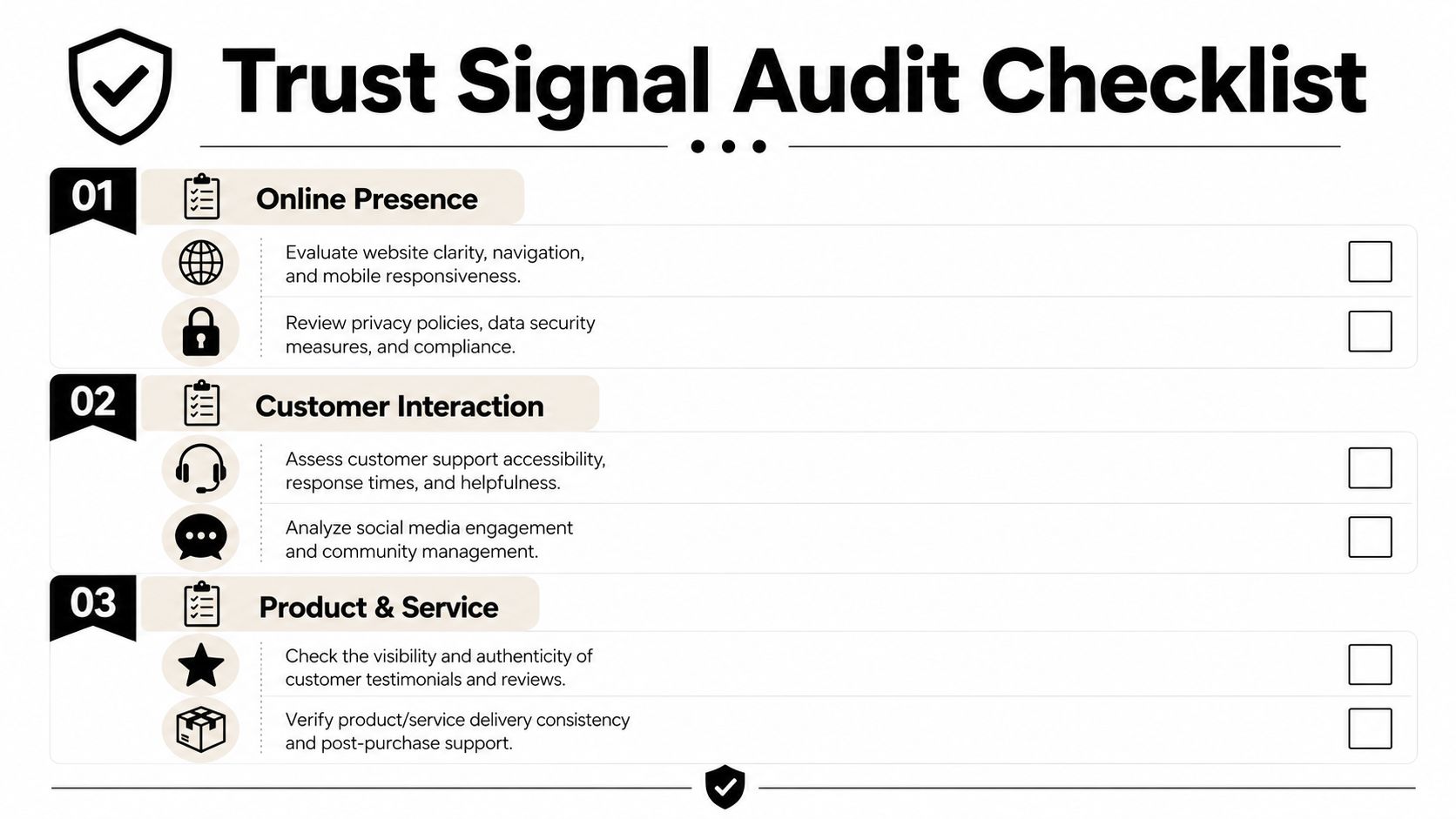
A trust audit provides a clear view of what exists, what is underperforming, and where friction is undermining buyer confidence.
Start with the buyer path
Open your site and move through it like a skeptical first-time buyer. Do not evaluate it as the person who built it. Evaluate it as someone deciding whether your claims are safe to trust.
Check these touchpoints in sequence:
-
Homepage credibility
- Can a visitor understand what you do without interpreting jargon?
- Is there visible proof that real customers use the product or service?
- Are trust elements current, or do they appear neglected?
-
Product and pricing pages
- Is pricing understandable without requiring a sales call?
- Do claims about speed, quality, or outcomes have supporting evidence nearby?
- Are policies, guarantees, and limitations easy to locate?
-
Checkout or conversion flow
- Does friction increase immediately before the form, cart, or payment step?
- Are reviews, testimonials, or reassurance elements present where hesitation peaks?
- Are there surprise requests, hidden fees, or unclear next steps?
Audit outside the website
Trust does not reside only on owned pages. Buyers also evaluate your review footprint, social responses, founder presence, and support responsiveness.
Use a simple three-column worksheet:
| Surface | What customers see | Trust risk |
|---|---|---|
| Review platforms | Mixed quality, uneven recency | Looks unmanaged |
| Social channels | Fast posts, slow replies | Feels performative |
| Support inbox | Helpful answers, inconsistent timing | Reliability feels uneven |
This step often reveals the underlying issue. Many companies have competent messaging but inconsistent execution. The website feels polished, while support emails feel rushed. Social channels communicate customer focus, while cancellation or return processes feel defensive.
The quickest way to weaken trust is to sound premium in marketing and ordinary in operations.
Prioritize gaps by buying friction
Do not attempt to fix everything simultaneously. Rank issues by their proximity to revenue.
A missing team photo on the About page matters less than missing reassurance on a pricing page. An outdated testimonial gallery matters less than silence near a checkout button. Prioritize the moments where buyers ask, “Can I trust this enough to continue?”
A practical trust audit typically produces a concise action list:
- Move proof closer to decisions: Add customer evidence near forms, plan selectors, and payment steps.
- Tighten policy clarity: Rewrite returns, onboarding expectations, and response commitments in plain language.
- Standardize tone across channels: Align website copy, email replies, and social responses so the company presents itself consistently.
Run this audit quarterly. Trust drifts as teams publish new pages, introduce offers, or change fulfillment without updating the surrounding proof.
Collecting Authentic Testimonials at Scale
Once you know where trust is weak, you need a dependable process for gathering customer proof. Many organizations underperform at this stage.
They ask once, ask too broadly, or ask in a format that creates unnecessary work for the customer. Then they conclude that customers are unwilling to share feedback. In reality, the request is usually the problem.
Effective collection systems reduce friction, personalize outreach, and make the next step obvious.
Ask at the moment of earned satisfaction
Timing matters more than volume.
The strongest request usually arrives immediately after a customer experiences a clear win: a successful onboarding, a resolved support issue, a repeat purchase, a completed project, or a milestone achieved with your product. At that point, the experience is specific enough to describe and recent enough to capture accurately.
Personalization matters as well. Salesforce notes that personalized email content improves click-through rates by 14% and conversion rates by 10%, which is why testimonial requests should reference the customer's actual experience rather than relying on generic batch messaging.
Compare these two requests:
- “Would you be willing to leave us a review?”
- “You mentioned your team moved through implementation faster once the reporting workflow was in place. Would you be open to sharing that in a short video or written testimonial?”
Only one of those reflects genuine attention.
Use a multi-format collection workflow
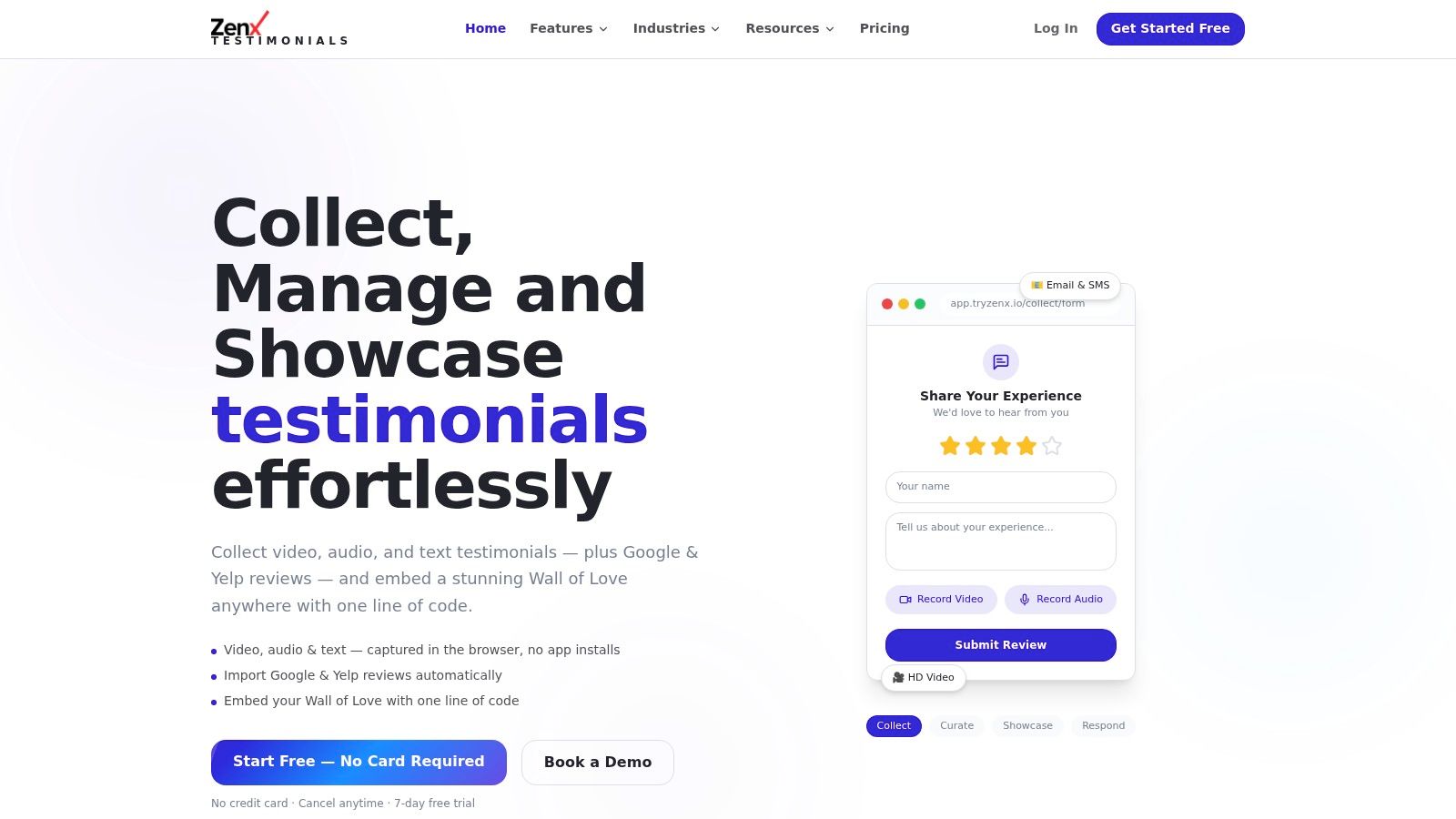
Not every customer wants to record a video. Some will gladly send a concise written quote. Others are on mobile and will respond to SMS more quickly than email. Give customers options.
A practical collection stack includes:
- Email for detailed asks: Best for B2B customers, account-based relationships, and use cases that require context.
- SMS for speed: Useful after service interactions, local business visits, or successful support resolutions.
- QR codes for in-person collection: A strong fit for clinics, retail counters, gyms, events, and hospitality businesses.
- Browser-based recording: Reduces drop-off because customers do not need downloads, accounts, or extra steps.
If you want a starting point for the messaging itself, use these testimonial request email templates as a reference and tailor them around the customer's specific result.
Standardize prompts so the feedback is usable
“Tell us what you think” sounds polite, but it rarely produces useful evidence.
Use prompts that surface decision-making detail:
- What problem were you trying to solve?
- What made you choose us over the alternative?
- What changed after you started using the product or service?
- What would you say to someone considering it today?
Those questions generate proof that future buyers can actually use.
Ask for specifics, not praise. “It saved me time” is weak. “It reduced manual follow-up and made our process easier to manage” is evidence.
Automate follow-up without sounding automated
Strong testimonial collection is structured, but it should not feel robotic.
A simple sequence works well:
- First request after the customer win
- One reminder a few days later
- A final follow-up that offers a lower-effort option, such as text instead of video
The key variable is tone. Keep the request concise, contextual, and easy to complete. Do not incentivize customers to sound positive. Do not over-script their response. The objective is to surface authentic language, not manufacture approval.
What works is clarity, convenience, and relevance. What fails is sending the same generic review request to every customer and hoping enough people respond.
Displaying Social Proof Where It Matters Most
A large testimonial library can still underperform if it appears in the wrong place.
Many companies place all of their customer proof on a single testimonials page in the footer and then wonder why conversions do not improve. Buyers rarely go searching for reassurance after uncertainty emerges. They need reassurance exactly where uncertainty appears.
That usually means product pages, pricing comparisons, proposal pages, demo follow-ups, and checkout flows.
Match proof to the objection on the page
Think in scenarios.
A buyer on your product page is not asking, “Do people like this brand?” The real question is, “Will this solve my problem?” Place testimonials there that address implementation, usability, results, or support quality.
A buyer reviewing pricing has a different concern: “Is this worth the cost?” That is where concise proof about value, reliability, and post-purchase outcomes is most effective.
A buyer at checkout is at the highest-friction moment. Anxiety centers on risk, not features. Place short, credible reassurance next to the final conversion action.
A practical placement map looks like this:
| Page type | Buyer hesitation | Best proof format |
|---|---|---|
| Product page | Will it work for me | Specific customer story |
| Pricing page | Is it worth the cost | Value-focused quote or video |
| Checkout flow | Is this safe to commit to | Short trust-focused testimonial |
Use third-party proof close to action
Placement can materially affect outcomes. Zendesk reports that placing third-party testimonials on product pages and checkout flows increases conversion rates by 15.8% on average, and video testimonials drive a 24% higher lift than text-only reviews because they are perceived as more authentic.
That does not mean every page needs a large video module. It means your strongest proof should appear where a customer is actively deciding whether to continue.
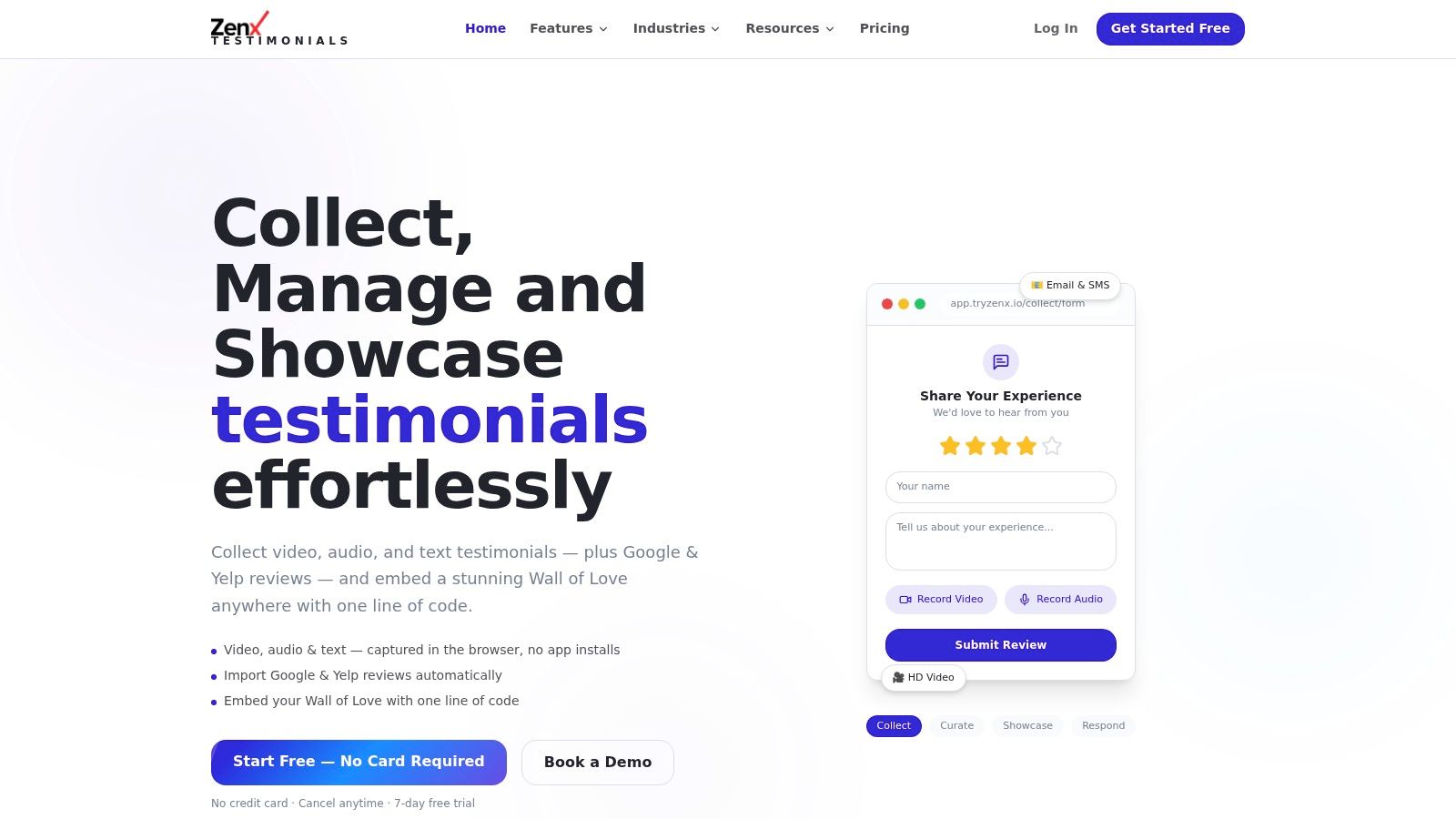
If you need implementation flexibility, embedded testimonial widgets can help teams publish proof without waiting on a redesign. For example, embeddable review widgets make it easier to place curated customer feedback in carousels, grids, or lightweight sections across landing pages and storefronts.
Do not over-polish the proof
There is a common mistake here. Teams often select only glowing one-line praise and remove anything that sounds human.
That reduces credibility.
Mixed sentiment can be useful when it is honest and contextual. A review that says onboarding required effort but support remained responsive often feels more credible than a stack of flawless five-star statements that read like marketing copy. Buyers do not need perfection. They need evidence that the experience is real and that your company shows up when the process is not frictionless.
Social proof performs best when it answers a buyer's doubt in the buyer's own language.
What works is relevance, proximity, and credible detail. What does not work is dropping a generic review feed onto the site and calling it a trust strategy.
Engaging with Feedback and Managing Reviews
Trust grows when customers can see that feedback leads to action.
That includes the obvious cases, such as negative reviews and public complaints. It also includes quieter moments, such as a customer asking a fair question, pointing out a confusing step, or leaving a mixed review that deserves a thoughtful reply. If your company only engages when praise appears, customers notice.
The challenge today is scale. Higher review volume, more channels, and the rise of AI moderation have made response workflows faster, but they have also made them easier to mishandle.
Use AI for speed, not for impersonation
The trade-off is straightforward. Teams want faster moderation and quicker replies, but customers still want to know that a real person is paying attention.
That tension is real. AnswerConnect notes that 85% of consumers prefer human agent interaction over AI bots, which is why review operations need clear boundaries around automation. AI can help classify sentiment, flag abuse, suggest drafts, and group recurring themes. It should not fabricate customer voice or publish synthetic testimonials that blur the line between real feedback and generated content.
A useful principle is this: use AI to assist judgment, not replace accountability.
Build a review response policy your team can follow
Most teams do not need more enthusiasm. They need response standards.
Use a lightweight policy with four parts:
- Ownership: Assign a real person or team to each review channel so nothing remains unaddressed.
- Reply style: Keep responses plain, specific, and tied to the customer's actual point.
- Escalation path: Route billing, safety, or service failures to someone who can resolve the issue.
- Disclosure: If AI helps draft replies or moderate content, keep human review in the loop.
For businesses that manage public review volume across channels, tools like Google review management workflows can support faster triage and suggested replies. The critical point is that a human still approves the final response and adjusts the wording to fit the situation.
Respond in a way that signals competence
A strong response does not need to be long. It needs to be useful.
For positive reviews, acknowledge the specific experience. For mixed feedback, thank the customer for the detail and address the issue without defensiveness. For negative reviews, avoid generic apology language unless it is paired with a corrective step.
A practical standard is this: every public response should show that your team understood the issue, cared enough to respond, and knows what happens next.
That is what turns review management from reputation control into trust-building behavior.
Measuring and Improving Your Trust Score
If trust is not measured, teams default to anecdotes.
Someone says reviews feel stronger lately. Someone else says support seems faster. Marketing assumes the testimonial page is helping because it looks better than it did six months ago. None of that is sufficient. Trust requires a formal scorecard.
That matters because weak measurement leads to weak execution. Mastercard highlights that organizations that fail to implement formal trust assessment metrics see 80% of their customer trust initiatives lack measurable outcomes, and that listening without implementing changes destroys trust 47% faster than ignoring feedback entirely. The message is clear. Collecting feedback without action can damage trust.
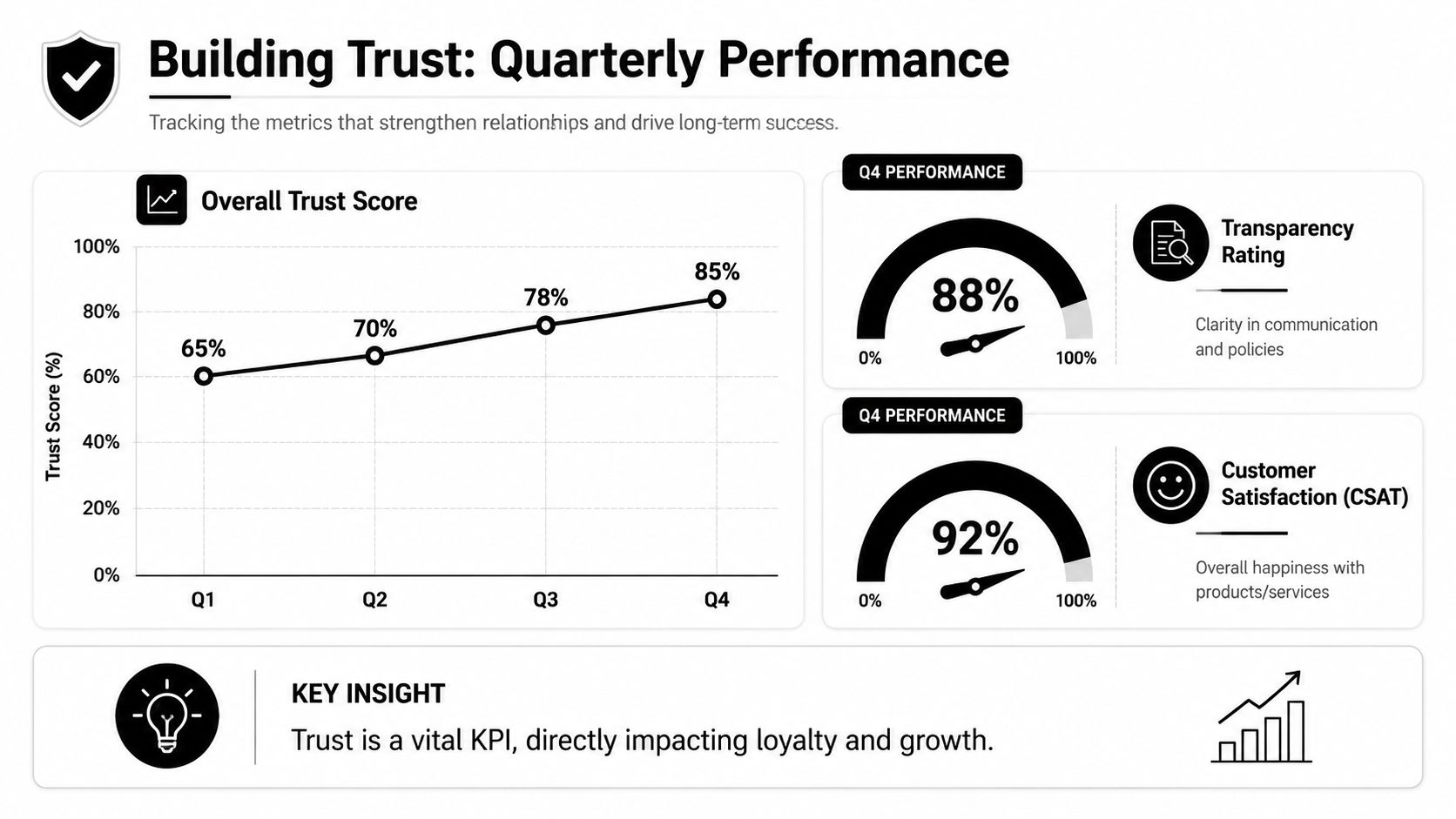
Create a simple trust barometer
You do not need a complex model to begin. You need a consistent one.
Build a quarterly survey around four dimensions often used in formal trust assessment:
- Reliability: Do customers believe you keep promises?
- Competence: Do they believe your team can solve the problem effectively?
- Transparency: Do they understand pricing, policies, and limitations?
- Values alignment: Do they believe the company behaves responsibly?
Ask straightforward questions such as:
- This company delivers on its promises
- I understand what to expect from this company
- This company communicates openly when something changes
- I would feel comfortable buying from this company again
Keep the wording stable each quarter so trends remain comparable.
Tie trust metrics to behavior
A trust score becomes useful when it is connected to operating data.
Compare survey results against:
- Repeat purchase behavior
- Upgrade or expansion patterns
- Support resolution experience
- Review sentiment themes
- Conversion performance on high-intent pages
If reliability scores decline and refund-related complaints increase, that is not a brand issue. It is a fulfillment or expectation-setting issue. If transparency scores are weak while pricing page abandonment remains high, your copy and offer structure may be creating avoidable uncertainty.
Measure trust as a leading indicator. Revenue tells you what happened. Trust signals often indicate what will happen next.
Turn feedback into a quarterly improvement cycle
The final step is governance. Someone has to own the loop.
A practical quarterly cadence looks like this:
- Collect input: Pull survey responses, reviews, support themes, and sales objections.
- Cluster issues: Group feedback into recurring trust problems such as unclear pricing, slow follow-up, or weak onboarding guidance.
- Assign fixes: Put an owner and deadline on each issue.
- Re-measure: Check whether the next quarter shows movement in both perception and behavior.
Trust becomes concrete in application. Product teams can own onboarding clarity. Marketing can own proof placement and promise accuracy. Support can own response quality and escalation speed. Leadership can review the full picture and decide where trust is leaking.
Businesses that want to scale trust across the organization also need shared metrics at the leadership level. PwC's trust in business survey overview reinforces the need for a common set of metrics so leaders can identify trust gaps before they affect engagement, expansion, and profitability.
The most important factor is consistency. Do not run a single customer survey, share the results in Slack, and move on. Treat trust like any other operating KPI. Track it, review it, and act on it.
If you want a faster way to operationalize this process, ZenX Testimonials gives teams one place to collect video, audio, and text testimonials, import third-party reviews, manage moderation, and publish social proof across key pages without heavy developer work. It is a strong fit for teams ready to turn trust from a vague brand objective into a measurable workflow they can run every week.
Written by
Sunil
ZenX Testimonials
Sunil writes about reviews, testimonials, and the everyday work of earning customer trust.