Online Reputation Management for Small Businesses: Grow In 2026
A practical online reputation management guide for small businesses: a weekly workflow, review response templates, and how to measure ROI.
In this article
- Your Reputation Is Your Most Valuable Asset
- What Online Reputation Management Really Means for You
- The Five Pillars of an Effective ORM Strategy
- A Step-by-Step Reputation Management Workflow
- Review Response Templates You Can Use Today
- Measuring the ROI of Your Reputation Efforts
- Take Control of Your Business's Story
You search your business on Google and the first thing you see is a one-star review. Your mind jumps straight to the worst-case scenario. How many prospects will read it and move on without calling, booking, or visiting?
That is when reputation management stops sounding like marketing jargon and starts feeling like a real business issue. Most owners react in one of three ways. They ignore the review, reply too fast, or promise themselves they will deal with it later.
Usually, later never comes.
Here is the reality. Your reputation is being shaped every day, whether you manage it or not. Reviews, replies, outdated listings, and missed follow-ups all affect how prospects judge your business before they ever contact you.
The real question is simple. Are you shaping that story on purpose?
Your Reputation Is Your Most Valuable Asset
Many owners treat reviews like weather. Good comments are nice. Bad ones are just part of the internet. That mindset costs money because reviews are part of the buying process.
Nearly all consumers, 97%, read online reviews before selecting a local business, according to this small business reputation guide. If you run a dental office, gym, law firm, restaurant, or home service company, your reputation is often your first salesperson.
The problem usually is not one bad review. It is an unmanaged profile that tells an incomplete story. Maybe you have too few reviews. Maybe the newest one is months old. Maybe happy customers are never asked, while unhappy customers find the review page on their own.
That is why ORM is not just damage control. It is a system for building trust.
Why the first bad review feels bigger than it is
A negative review feels personal because your business is personal. But one review does not define you. A thoughtful reply, steady review collection, and visible follow-through usually matter more than the complaint itself.
Practical rule: Never treat a negative review as a one-off. Treat it as a sign that your review process is too passive.
When you move from reactive mode to routine mode, the goal changes. Instead of asking, “How do I make this review disappear?” you ask, “How do I make sure the next ten customers see a fuller picture?”
That shift leads to better systems, better responses, and a healthier flow of feedback.
What Online Reputation Management Really Means for You
Online reputation management sounds technical, but for a small business it is simple. It is the work of making sure your online presence matches the quality of your actual service.
Think less about PR and more about shopkeeping.
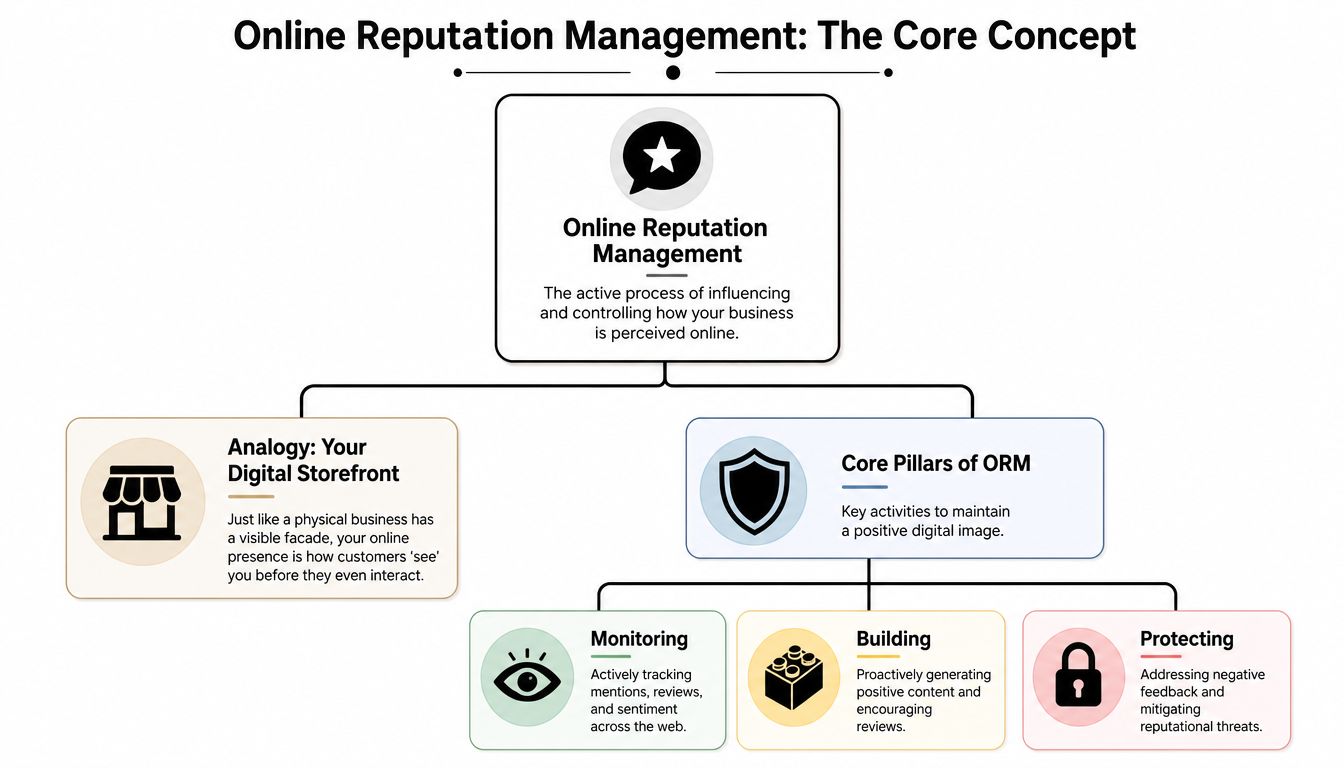
Think of ORM as your digital storefront
If someone passed your storefront and saw dirty windows, old signage, and irritated customers, you would fix it. Your review profiles work the same way. They shape first impressions before anyone talks to you.
A good reputation is not just having more positive reviews than negative ones. It has to clear a credibility threshold. A 4-star rating is that threshold for many local businesses because 92% of consumers require at least a 4-star rating before they'll even consider a local business, based on this ORM overview.
If you are below that line, many buyers will screen you out before you get a chance to compete.
The three jobs ORM has to do
For most small businesses, ORM comes down to three jobs.
-
Monitoring
Know what people are saying, where they are saying it, and how recently they said it. That includes Google, Yelp, Facebook, and any industry-specific platform. -
Responding
A review is not just feedback for you. It is public proof for future customers. Your reply shows whether you are attentive, defensive, helpful, or absent. -
Amplifying
Positive experiences should not stay buried on third-party platforms. Strong feedback should become visible trust signals on your website, landing pages, and sales materials.
The most common mistake is over-focusing on replies and under-focusing on review generation. Polite replies help, but they do not fix a weak profile on their own.
A weak profile with polite replies is still a weak profile.
A quick self-check:
| Area | Weak setup | Strong setup |
|---|---|---|
| Visibility | Reviews scattered, rarely checked | One routine for checking everything |
| Response habits | Replies are late or inconsistent | Replies follow a clear standard |
| Social proof | Great customer feedback stays hidden | Best feedback gets reused where buyers see it |
Most businesses do not need a complex strategy. They need a simple one they will actually maintain.
The Five Pillars of an Effective ORM Strategy
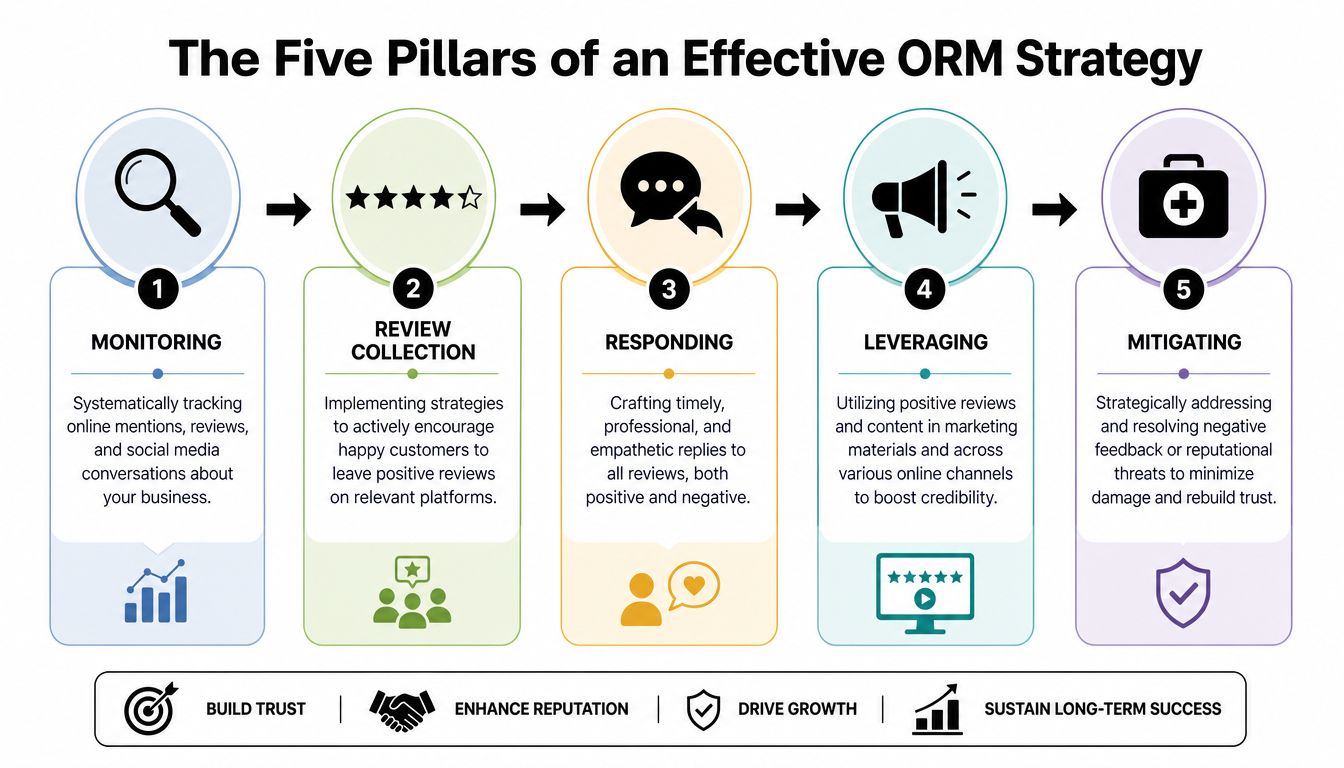
A useful ORM strategy has five parts. Miss one and the rest get harder. Do all five consistently and your reputation starts working like a real business asset.
Online reputation management explains 35% of the variance in overall small business performance, according to the Journal of Small Business Strategy study on reviews and revenue. That makes ORM a performance driver, not a side task.
A strategy that works in real life
Monitoring is the base layer. If reviews are spread across Google, Yelp, Facebook, and industry sites, you need one routine or dashboard to keep them visible.
Review collection keeps your profile current. Happy customers are often willing to leave feedback, but most will not do it unless you ask at the right moment and make it easy.
Response is public customer service. It is not about winning arguments. It is about showing future buyers that you listen, take ownership, and follow up.
What good execution looks like
The last two pillars are often overlooked.
- Remediation means fixing the issue behind the complaint. If the same criticism appears more than once, you likely have an operations problem, not a reviewer problem.
- Amplification means using positive reviews where they influence decisions most. A testimonial on a third-party platform helps. A testimonial on your site or landing page helps more.
Businesses that improve fastest usually do four things well:
- Ask consistently: Review requests are built into checkout, delivery, follow-up, or appointment completion.
- Reply calmly: Responses follow a process instead of being improvised.
- Flag patterns: Repeated complaints are tracked and fixed.
- Reuse proof: Positive feedback is turned into visible assets across marketing channels.
If you're looking at software options, a dedicated Google review management workflow can help centralize review monitoring and response tasks. The goal is not more complexity. It is less manual work.
Good ORM feels boring, consistent, and effective. That is exactly what you want.
A Step-by-Step Reputation Management Workflow
Most owners do not need more theory. They need a weekly system they can run without hiring an agency.
A practical workflow for online reputation management for small businesses should do four things: collect feedback, surface reviews fast, shorten response time, and place the best proof where prospects can see it.
Your weekly system in practice
Start by gathering every review source into one place. A spreadsheet works at first. The goal is to stop bouncing between tabs and forgetting what needs a response.
Then run this routine:
-
Check new reviews and mentions
Review new feedback across your main platforms. Sort by newest first. Flag anything that needs a same-day reply. -
Send review requests to recent happy customers
Use email, SMS, or a QR code that points to the right review page. Keep the request short and tied to a recent completed experience. -
Organize the best feedback
Tag strong reviews by service, location, use case, or customer type so you can reuse them later. -
Publish selected reviews to your site
Add strong text, audio, or video testimonials to service pages, booking pages, and landing pages.
Consumers read an average of 10 reviews before they feel confident enough to trust a business, according to Reputation X review statistics. One glowing review is not enough. You need steady volume and recent proof.
The hybrid response workflow that saves time
Review responses often become a bottleneck. Writing every reply from scratch is slow. Generic templates sound robotic. Full automation can sound worse.
The practical middle ground is an AI-draft plus human-finalize workflow.
The approach is simple:
- Use AI for speed: Let a tool draft the first reply based on review type and brand tone.
- Use a human for judgment: Check facts, add specifics, remove canned language, and avoid promises you cannot keep.
- Keep review requests clean: Do not incentivize reviews or reward only positive feedback.
- Move sensitive issues offline: For billing, scheduling, or privacy-sensitive matters, acknowledge the issue publicly and continue privately.
That balance matters because 70% of consumers expect a response within 24 hours, as noted in Velocity Partners Group's discussion of monitoring online reputation. Speed matters, but tone matters too.
What works:
- Drafting first responses with AI
- Editing every reply before posting
- Using templates as structure, not final copy
- Sending review requests through email, SMS, or QR codes after completed service
What does not:
- Posting untouched machine-written replies
- Using the same reply for every reviewer
- Offering incentives for favorable reviews
- Arguing publicly when the goal is trust restoration
Fast and human beats perfect and late.
If you can protect one hour a week for this workflow, you can keep your reputation moving in the right direction without turning it into a second full-time job.
Review Response Templates You Can Use Today
Most owners do not struggle with the idea of responding. They struggle with the blank box.
A good reply does three things. It acknowledges the customer, shows professionalism to future readers, and keeps your team from responding emotionally. If you want a starting library, a set of structured review reply templates can save time.

How to write replies that sound human
A few rules improve almost every response:
- Start with the person: Use their name if the platform shows it.
- Acknowledge specifics: Mention the service, team member, or detail they referenced.
- Stay brief in public: Long explanations often sound defensive.
- Take complex issues offline: Invite direct contact when facts need review.
- Never litigate the review: Future customers care more about your tone than the argument.
The goal of a review response is not to prove you were right. It is to show that dealing with your business is safe.
Copy and paste templates
For a simple positive review
Thanks, [Name]. We appreciate you taking the time to leave a review. We're glad you had a good experience with [service or business name], and we look forward to helping you again.
Why it works: Short, warm, and easy to personalize.
For an enthusiastic positive review with specifics
Thank you, [Name]. We're really glad to hear that [specific detail they mentioned] stood out. Our team works hard to make the experience smooth from start to finish, so it's great to know that came through. We appreciate your support.
Why it works: It rewards the reviewer with attention, not just a canned thank-you.
For a negative review about a service failure
Hi, [Name]. I'm sorry to hear this was your experience. This isn't the standard we aim to deliver. We'd like to look into what happened and make sure the issue is properly addressed. Please contact us at [best contact method] so we can follow up directly.
Why it works: It acknowledges the problem without arguing facts in public.
For a review with factual inaccuracies
Hi, [Name]. Thank you for sharing your feedback. We take concerns like this seriously. Some of the details in your review don't match our records, and we'd like the chance to review this with you directly. Please reach out to us at [contact method] so we can better understand what happened.
Why it works: It corrects carefully without calling the reviewer dishonest.
For a lukewarm three-star review
Thanks, [Name], for your feedback. We're glad to hear [positive element], and we appreciate your note about [issue]. Feedback like this helps us improve, and we're reviewing it with our team.
Why it works: Three-star reviews often contain your best operational feedback. Treat them like free consulting.
You do not need poetic replies. You need calm, specific, consistent ones.
Measuring the ROI of Your Reputation Efforts
A reputation program becomes sustainable when you can see what it is doing for the business. If it stays vague, it gets pushed behind payroll, staffing, and every other urgent task.
The good news is that you do not need a complex attribution model. You need a few indicators that show whether trust is getting easier to earn.
The numbers that actually matter
Start with a simple scorecard.
| Metric | What to watch | Why it matters |
|---|---|---|
| Average star rating | Whether your profile is improving or slipping | It shapes first impressions |
| Review volume | Whether you have enough recent proof | Buyers want more than one or two opinions |
| Review velocity | Whether new reviews come in regularly | Freshness signals that the business is active |
| Response coverage | Whether most reviews receive replies | Consistency reflects attentiveness |
| Recurring themes | What people repeatedly praise or criticize | This shows what to fix or promote |
You do not need to obsess over every platform equally. Focus first on the review sources your customers actually check before buying.
How to connect reputation work to business results
The business case gets clearer when you compare reputation activity with outcomes you already care about. Watch what happens to form fills, booked calls, appointments, checkout confidence, or close rates after your review profile becomes stronger and more current.
There is also a direct financial case. 61% of small businesses report that positive online reputations directly contribute to improved cash flow, according to New Media's reputation management statistics.
A straightforward monthly review can include:
- Lead quality: Are prospects showing up with fewer trust objections?
- Conversion behavior: Are more visitors taking the next step on high-intent pages?
- Operational feedback: Are recurring complaints declining after process fixes?
- Cash flow signals: Are stronger trust signals helping you close work faster?
If you want to model the business impact, a simple reputation ROI calculator can help frame what better review volume and stronger trust signals might mean for revenue decisions.
Do not overcomplicate ROI. If reputation work helps more prospects trust you, choose you, and buy sooner, it is doing real business work.
Take Control of Your Business's Story
Most small businesses inherit their online reputation by accident. A few reviews trickle in. One bad experience gets posted. Happy customers say nice things in person but never write them down. Over time, the public version of the business drifts away from reality.
That drift is fixable.
Online reputation management for small businesses works best as a routine, not a rescue plan. Monitor your main platforms. Ask happy customers for reviews consistently. Reply with empathy and clarity. Fix repeat issues. Reuse strong feedback where future buyers can see it.
You do not need a dedicated team. You need a repeatable workflow and the discipline to run it every week.
When you manage your reputation on purpose, you stop letting the loudest review define your business. You start building a fuller, more credible story.
If you want a simpler way to collect, manage, and display customer proof without adding more admin work, ZenX Testimonials is worth a look. It helps you gather text, audio, and video testimonials, import third-party reviews into one place, organize feedback fast, and publish social proof on your site with minimal setup. For a busy owner or lean marketing team, that kind of tool can turn good intentions into a repeatable process.
Written by
Sunil
ZenX Testimonials
Sunil writes about reviews, testimonials, and the everyday work of earning customer trust.