How to Get More Google Reviews: A 2026 Playbook
A practical playbook for getting more Google reviews: when to ask, which channels work, request templates, and how to keep reviews coming steadily.
In this article
84% of consumers trust online reviews as much as personal recommendations, and 96% read reviews before visiting a business, according to 2025 Google review statistics. That reality changes the role reviews play in growth. They are not simply a reputation layer. They are a core part of customer acquisition.
Many businesses still approach review generation as an occasional favor, requested only when someone on the team remembers to ask. That creates spikes, dry periods, and profiles that appear inactive. If you want to understand how to get more Google reviews, you need a system built on clear triggers, smart channel selection, and minimal friction.
The strongest review programs do not depend on enthusiasm alone. They depend on process. You identify the right moment, remove unnecessary steps, route the request through the most effective channel, and respond in a way that reinforces trust. When executed well, reviews stop being random and become operational.
Why Most Review Strategies Fail
The standard advice is simple: ask more customers. On its own, that advice is incomplete.
The issue is rarely customer willingness. It is usually structure. Teams ask too late, choose the wrong channel, send customers to the wrong destination, or use language that feels generic and impersonal. Then they assume customers are unwilling to leave reviews.
Sporadic asking creates weak signals
A review strategy breaks down when it depends on memory. Front desk staff forget. Account managers hesitate. Service teams wait for the perfect moment and miss it. The result is inconsistent review velocity and uneven review quality.
That matters because Google does not only consider total review count. Active profiles and recent engagement carry weight. A stop-start approach leaves too much to chance.
Practical rule: Reviews perform best when they are treated as a post-service workflow, not a marketing campaign.
Most businesses add friction without noticing
A customer finishes a project, receives a thank-you email two days later, opens it on mobile, clicks a homepage link, lands on a general contact page, and abandons the process. Nothing in that sequence is intentionally difficult. It is simply inefficient.
Common failure points tend to appear in the same places:
- Bad timing: The request arrives after the moment of satisfaction has passed.
- Wrong channel: The customer receives an email when a text message would have been easier to act on.
- Generic copy: The message feels like a bulk send.
- Unclear destination: The link does not take the customer directly to the review prompt.
Asking is not the strategy
Businesses that generate reviews consistently build a repeatable engine. They define the trigger, automate the send, keep the path short, and train staff to support the process in person when appropriate.
That is the difference between random review collection and a system that compounds over time. One depends on luck. The other produces a reliable stream of social proof.
Build Your Review Foundation Before You Ask
Before you send a single request, make the destination as frictionless as possible. If the profile is incomplete or the review path is clumsy, every future request will underperform.
Make your profile review-ready
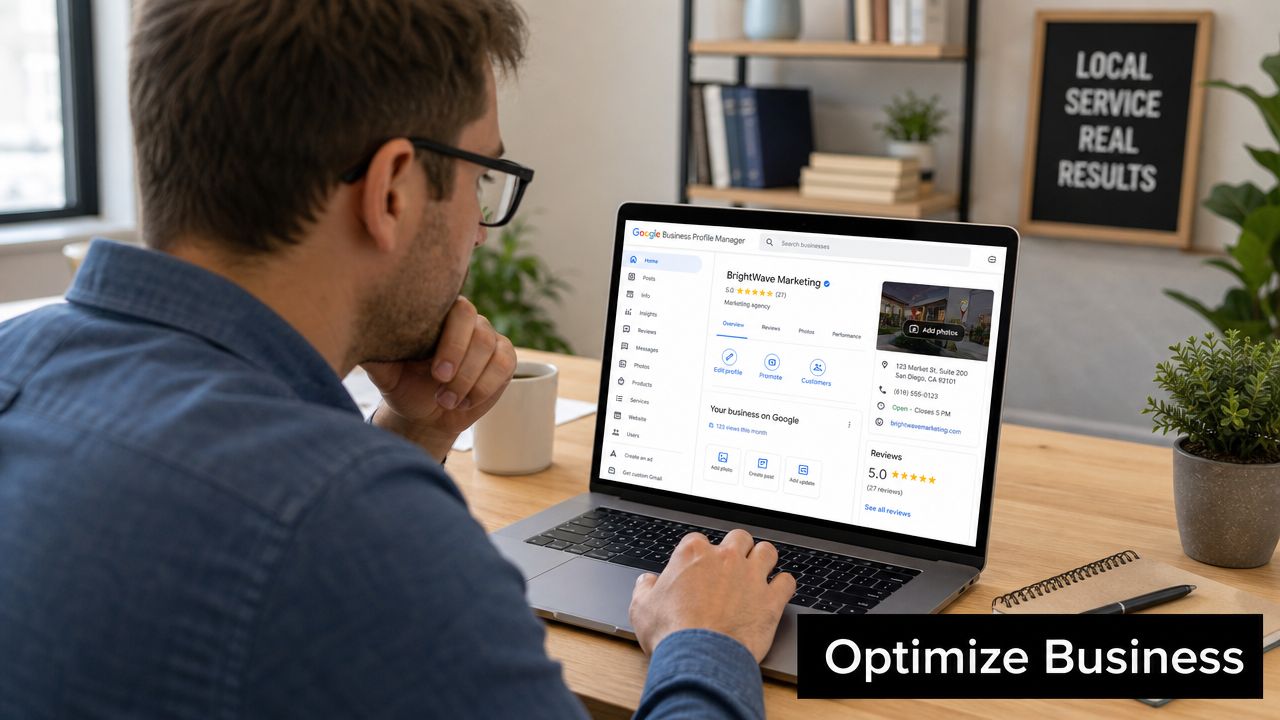
Start with the fundamentals inside your Google Business Profile. Your business name, categories, hours, service areas, phone number, and photos should all be accurate and current. Customers make quick judgments, and a neglected profile forces even strong reviews to work harder.
Then review your public profile as if you were a first-time buyer. Read the business description. Scan recent reviews. Assess the photos. If the profile feels outdated, address that before directing more customers to it.
A review engine performs better when the destination already signals credibility.
Create a direct review path
This is the technical step many teams overlook. They send customers to a search result, a homepage, or a profile page with multiple options. Every additional choice reduces completion.
A stronger setup is direct and unambiguous. As noted in this practical guide on review collection, a critical technical specification for success is the creation of a "zero-click" review landing page (for example, reviews.yourbusiness.com) containing only the Google review link, which removes all navigational ambiguity and is universally deployable across business cards, receipts, and email signatures.
That page should serve one purpose: opening the review flow.
Keep the landing page intentionally minimal. No menu. No offers. No secondary CTA.
Use the same link everywhere
Once the direct link exists, standardize it across all touchpoints. Do not let one team use a QR code to the homepage while another pastes a different review URL into SMS.
Use one canonical route in:
- Receipts and invoices
- Email signatures
- Printed QR cards
- Support follow-ups
- Post-service automations
If you are also collecting broader sentiment before asking for a public review, pair this setup with a structured customer feedback workflow so your team can separate service recovery from review solicitation.
Foundation checklist
A strong setup is straightforward to audit:
| Element | What good looks like |
|---|---|
| Profile accuracy | Hours, categories, contact details, and photos are current |
| Review link | Direct path to the Google review prompt |
| Landing page | Custom short URL with one action only |
| Team usage | Same link used across SMS, email, print, and in-person asks |
| Mobile experience | Fast, clear, and easy to complete on a phone |
When this foundation is in place, every request has a better chance of converting.
Master the Ask with Smart Timing and Channels
Timing is where a significant amount of review volume is lost. A customer may be satisfied and still ignore your request if it arrives after the moment has passed, through the wrong channel, or with too much friction.
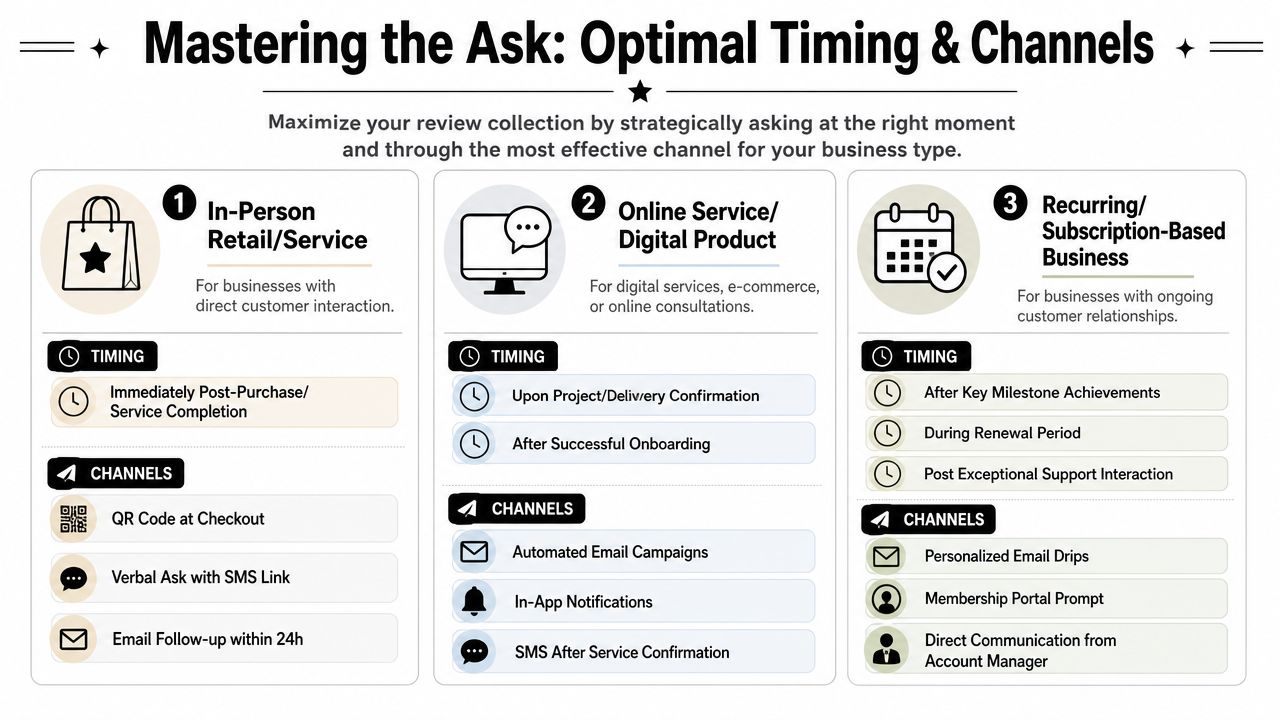
The practical objective is simple: trigger the request as close as possible to visible satisfaction, then deliver it through the channel the customer is already using. That is how review generation becomes a system instead of a campaign.
Ask at the moment of confirmed value
The right trigger is not merely purchase completion. It is evidence that the customer achieved the outcome they wanted.
For a home service company, that usually means the technician has completed the work, the customer has seen the result, and the conversation ends positively. For a SaaS business, it is often after onboarding success, a resolved support issue, or a feature activation tied to meaningful usage. For agencies, the cleanest moments are approval, launch, or a reporting milestone that demonstrates progress.
The most effective way to manage this is to map the ask to an operational event, not a marketing assumption. If a CRM stage changes to "job completed and confirmed," the review workflow begins. If a support ticket closes with a positive CSAT response, the workflow begins. That removes the inconsistency that appears when teams rely on memory.
Channel choice changes completion rate
SMS, email, QR codes, and NFC all have valid use cases. The mistake is treating them as interchangeable.
| Channel | Best use case | Strength | Limitation |
|---|---|---|---|
| SMS | Recent service completion, mobile-first customers | Fast action, low friction | Limited room for context |
| Digital products, invoices, onboarding completion | More space to personalize | Easier to ignore | |
| QR code | In-person environments | Immediate access at the moment of satisfaction | Weak if staff does not prompt |
| NFC with QR backup | Reception, tables, counters | Faster tap-to-open for compatible phones | Needs physical placement and upkeep |
SMS usually performs best when the experience has just happened and the customer already has a phone in hand. Email works better when a small amount of context improves the request, such as after project delivery, payment confirmation, or onboarding completion. QR codes perform best in physical environments where staff can ask verbally and point the customer to the next step.
NFC can be useful, but only for businesses that will maintain the hardware consistently. It is not worth adding unless the team can keep tags functional, visible, and supported by a printed QR code.
Build channel rules instead of letting staff improvise
A repeatable review engine requires channel logic.
Use SMS first for field services, clinics, salons, restaurants, gyms, and repair shops. The customer has just had the experience, and the path to review is short.
Use email first for software, ecommerce post-purchase flows, consulting, and higher-consideration services where a brief sentence of context improves response quality. If you need examples, these testimonial request email templates are a useful starting point for adapting tone by business model.
Use QR in person at the exit point, front desk, register, table, or service counter. This aligns with standard QR code best practices in review collection. The request is more effective when staff says it aloud first, then hands over the card or points to the sign.
One prompt. One link. One action.
Match the trigger to the business model
Here is a practical framework:
- In-person retail or service: Ask on-site immediately after completion. If the customer does not act in the moment, send an SMS follow-up soon after.
- Online service or digital product: Trigger after delivery confirmation, activation, onboarding success, or support resolution. Use email when context helps. Add SMS only if the customer relationship already supports it.
- Recurring or subscription business: Ask after a clear win, such as a renewal, milestone, or standout support interaction. Do not tie the request to routine billing events unless the customer has already expressed satisfaction.
This also matters for compliance. A well-timed request sent to the right segment is easier to defend operationally than sending every customer the same message on a fixed schedule.
What usually underperforms
Three patterns consistently appear in weak review programs:
- Batch sends at the end of the week or month
- Requests triggered by payment alone
- Generic prompts with no staff handoff or event-based logic
Those approaches create activity without intent. Teams send more messages, but response rates decline because the timing is disconnected from the customer experience.
The stronger model is event-driven. Ask after satisfaction is visible. Choose the channel that fits the context. Automate the trigger so the system continues to run even when the team is busy.
Write Review Requests That Earn a Click
The message matters because customers recognize automation immediately. That is not the problem on its own. The problem is poor automation.
An effective review request feels personal, concise, and easy to act on. It does not plead. It does not over-explain. It reminds the customer what happened and presents one obvious next step.
The anatomy of a high-converting ask
The best-performing requests usually include four elements:
- A personal opener: Use the customer's first name.
- A specific reference: Mention the service, product, technician, or project.
- A simple reason: Explain that the feedback helps future customers or supports the team.
- A direct link: No searching, no navigation, no extra clicks.
The practical guide from Funk Levis notes that personalization layers such as using the customer's first name, referencing the specific technician or service, and attaching a team member photo improve trust and follow-through when the request feels human instead of generic.
SMS examples that sound professional and personal
These examples work because they are direct and easy to act on.
Home services
Hi Maya, thank you again for choosing us for your AC repair today. If you have a minute, we would appreciate a quick Google review for Alex's work: [review link]
Dental or clinic follow-up
Hi Jordan, glad your visit went smoothly today. If you are open to it, we would value your feedback on Google: [review link]
SaaS support resolution
Hi Priya, pleased we were able to resolve the integration issue. If the support was helpful, would you mind sharing a quick Google review here: [review link]
Email examples with a bit more context
Email gives you more room to anchor the request in the actual outcome.
Subject: Thank you for working with us, Sam
Hi Sam,
Thank you again for trusting us with your kitchen remodel. Your project with Elena's team is now complete, and we would appreciate hearing about your experience.
If you are open to sharing it, you can leave a Google review here: [review link]
Your feedback helps other homeowners know what to expect, and it means a great deal to the team who completed the work.
Thanks again,
[Name]
Subject: A quick follow-up after onboarding
Hi Leah,
You have now completed onboarding and successfully set up your workspace. That is typically the point where customers begin seeing real value, which makes it an appropriate time to ask.
If you would be willing to share a quick Google review, please use this link: [review link]
Thank you for being a customer,
[Name]
Tighten your templates before you scale
Weak template habits spread quickly. Before rolling a request out across your team, review it for these issues:
- Too much brand language: Customers are not interested in your tagline inside a review request.
- No situational detail: "Thanks for your business" is easy to ignore.
- Buried CTA: The link should be immediately visible.
- Artificial enthusiasm: If it sounds scripted, rewrite it.
For more examples you can adapt across email follow-ups and campaign flows, use these testimonial request email templates.
Short is better than clever. Specific is better than polished.
Automate and Manage Reviews Like a Pro
Manual review collection starts to fail as volume increases. Add a second location, several account managers, or a higher transaction count, and the process begins to slip. Requests go out late, the wrong customers are asked, and no one clearly owns follow-up or replies.
The solution is operational. Build review collection into the systems that already govern the customer journey, then assign clear ownership for monitoring and response.
Use behavior-triggered workflows
The strongest review programs run on customer events, not reminders in a Slack channel.
A request should fire after a customer reaches a meaningful value moment. That could be a completed installation, a resolved support issue, an approved deliverable, a successful onboarding milestone, or a renewal. The exact trigger depends on the business model, but the principle remains the same. Ask after progress is felt, not simply after payment.
Good triggers include:
- Completed purchase or payment receipt
- Support ticket marked resolved
- Renewal confirmed
- Onboarding milestone completed
- Project approved or delivered
Keep the workflow simple. The event occurs. The system sends the request through the right channel. The customer lands on a direct review page. The team is notified when a review arrives or when a low-rating signal requires attention.
Keep automation compliant
Automation should remove manual work, not judgment.
The most common compliance mistake is tying rewards to positive reviews. That creates risk quickly. If you want more volume, ask every eligible customer through the same workflow and keep the request neutral. Do not filter for happy customers only. Do not suggest a star rating. Do not offer discounts, gift cards, or perks in exchange for praise.
It is also best to avoid scripting staff to ask for "five-star reviews." Train teams to deliver an experience worth mentioning by name. That produces better reviews and avoids language that may appear manipulative.
Treat response management as part of the system
A review engine includes inbound operations as well. If new reviews remain unanswered for days, automation on the request side only solves part of the problem.
Set response rules before volume increases. Decide who owns replies, how quickly the team should respond, which issues require escalation, and what should be taken offline. Positive reviews need short, specific responses. Negative reviews need triage, context, and a path to resolution.
That work is easier when alerts, assignments, and reply workflows live in one Google review management system instead of scattered inboxes and screenshots.
A practical response framework
For negative reviews, use a structure your team can repeat without sounding robotic:
- Acknowledge the issue clearly
- Apologize without arguing
- Reference the specific concern
- Offer a path to resolution
- Close professionally
Example:
Thanks for the feedback, Nina. I am sorry the installation timing caused frustration. That is not the experience we want clients to have. I have shared this with our operations lead, and we would like to make it right. Please contact us directly so we can resolve the issue with you.
For positive reviews, avoid generic thank-yous. Mention the service provided, the team member involved, or the outcome the customer highlighted. Those replies do more than show courtesy. They give future buyers additional detail when they scan your profile.
The operating model that scales
A review program becomes durable when each part has a clear role:
| Layer | Operational choice |
|---|---|
| Trigger | Send after a real value event |
| Delivery | Use the right channel for the context |
| Destination | Route to one direct review page |
| Compliance | No incentives tied to positive ratings |
| Response | Reply to every review with context and speed |
That system creates a steady flow of reviews without turning the process into spam or leaving your team to correct avoidable mistakes.
Turn Positive Reviews into Marketing Assets
A Google review can influence revenue long after it appears on your profile. Businesses that extract the most value from reviews do not treat them as passive reputation signals. They route them into pages, campaigns, and sales materials that help buyers make decisions.
Put reviews where buying decisions happen
Google is only the starting point.
Strong reviews belong on pages where intent is already high: service pages, pricing pages, quote request forms, proposal decks, onboarding flows, and checkout-adjacent sections. Match the review to the objection on the page. A quote about fast response times is useful near a contact form. A quote about measurable results fits better near a case study CTA or pricing section.
This matters because social proof performs better in context than in a generic testimonial slider.
Build a reusable content loop
One strong review should support more than one asset. That is how you turn review collection into a repeatable content system instead of a one-time success.
- Website proof blocks: Publish recent, relevant reviews on high-intent pages
- Sales collateral: Add short excerpts to proposals, one-pagers, and pitch decks
- Social content: Turn a customer quote into a simple post or branded image
- Email nurturing: Insert a review that matches the recipient's likely objection
- Case study sourcing: Flag detailed reviews as candidates for a fuller customer story
A review is customer-generated copy. Use it wherever trust needs reinforcement.
Use detail, not just praise
Short praise has limited marketing value. Specific praise helps move deals forward.
A review that names the service, mentions the team member, explains the timeline, or describes the outcome gives future buyers something concrete to believe. It reduces uncertainty because it answers the questions prospects already have: Will they respond quickly? Did the work solve the problem? Was the process smooth?
Collection quality affects repurposing quality. If your review requests prompt customers to mention what was delivered and what result they achieved, you will collect proof that is easier for marketing and sales teams to use later.
Extend the relationship after the review
A detailed public review is often the first signal that a customer is willing to do more. Use that moment well. Ask for a written testimonial, a short video, or a case study interview while the positive experience is still fresh.
This step works best with a simple follow-up path, not a manual scramble. Tag strong reviews, route them to the right owner, and trigger the next request based on what the customer already shared. That keeps the system efficient and avoids asking every satisfied customer for the same high-effort favor.
If you only collect the review and move on, you miss much of the value of the interaction. If you treat reviews as reusable trust assets, each one can support acquisition long after it is posted. Building that kind of system is what we focus on every day.
ZenX Testimonials helps teams collect, manage, and display social proof without stitching together separate tools. If you want one place to capture text, video, and audio testimonials, sync third-party reviews, moderate feedback, and publish a Wall of Love on your site, explore ZenX Testimonials.
Written by
Sunil
ZenX Testimonials
Sunil writes about reviews, testimonials, and the everyday work of earning customer trust.