Top Alternatives to Feedspace.io for Testimonials in 2026
Compare the top Feedspace.io alternatives for 2026 on testimonial collection, video, embeds, review imports, and pricing.
In this article
- The Search for a Better Testimonial System
- Why Businesses Move Beyond Traditional Review Tools
- Introducing ZenX Testimonials as the Superior Option
- Actionable Templates for High Response Testimonial Requests
- Implementing Your First Campaign in ZenX
- Managing and Publishing Your Social Proof for Growth
- SEO Legal and Industry Specific Guidance
Businesses rarely struggle to understand the value of testimonials. The challenge is building a reliable system to collect them, organize them, and publish them where they influence decisions.
Most teams begin with the obvious steps. They ask satisfied customers for feedback, send follow-up emails, and place a few positive quotes on the homepage. Some also try Feedspace.io and make partial progress. Even then, the process often remains fragmented. Video submissions stall. Text responses arrive without enough structure to publish confidently. Google reviews sit in one platform, Yelp reviews in another, and the most useful testimonials end up buried in inboxes or spreadsheets.
That is typically when businesses begin searching for Alternatives to Feedspace.io.
The important point is that this is not only a software comparison. In many cases, it is a workflow issue. The wrong platform creates friction for customers and additional administrative work for internal teams. The right platform simplifies collection, centralizes existing proof, and turns customer feedback into assets that can be used across the website, sales materials, and campaigns. If you are evaluating options, this roundup of the best testimonial software options is a useful starting point, but the larger opportunity is designing the collection system correctly from the beginning.
The Search for a Better Testimonial System
A consistent pattern appears across SaaS companies, local service businesses, agencies, and ecommerce brands.
A business delivers a positive result. The customer is satisfied. A testimonial request is sent. Then one of three things happens: the customer ignores the request, submits a response that is too vague to use, or agrees to record a video and never completes it.
In most cases, this is not because customers are unwilling to help. It is because the request arrives at the wrong time, uses the wrong format, or demands more effort than expected.
What the broken process looks like
Most underperforming testimonial systems show the same symptoms:
- Low-friction in theory, high-friction in practice because customers must install software, create an account, or decide on their own what to say.
- Scattered proof because Google, Yelp, email replies, support messages, and recorded clips are spread across separate tools.
- Manual curation because someone on the team must chase approvals, reformat text, edit videos, and manually place testimonials on pages.
- Weak publishing because collected feedback never reaches pricing pages, landing pages, sales decks, or proposal templates.
Practical rule: If collecting one testimonial creates two internal tasks, the system will not scale.
Why buyers start looking elsewhere
Teams do not usually replace a testimonial tool because of one missing feature. They move on because the full process feels heavier than it should.
The most effective systems are simpler. They ask at the right moment. They allow customers to respond in the browser. They support text, audio, and video in one place. They pull in third-party reviews so valuable proof is not trapped on external platforms. They also let teams publish from one centralized library instead of recreating the same assets repeatedly.
That is the standard a credible modern alternative must meet.
Why Businesses Move Beyond Traditional Review Tools
Many teams start with a basic goal: gather a few customer quotes. Within a few months, they often find themselves managing Google reviews in one platform, video clips in another, approval screenshots in Slack, and no efficient method to transform any of it into proof that helps advance pipeline.
At that point, the question changes. It is no longer, "What else works like Feedspace?" It becomes, "What system will help us collect better testimonials and actually use them?"
According to G2's Feedspace competitor comparison, buyers evaluating Feedspace also compare it with products such as Reputation, Sprinklr Social, Klaviyo, and Reviews.io. That matters because these tools were built for different purposes. Some focus on public review monitoring. Some are positioned closer to social media management. Some offer lightweight testimonial capture. Very few are designed to manage the full workflow from request through publication.
Where traditional review tools break down
Older review tools generally fall into one of three categories, and each category introduces a different operational limitation.
| Platform type | Usually good at | Usually weak at | Best fit |
|---|---|---|---|
| Reputation management tools | Monitoring public reviews, alerts, enterprise controls | Native testimonial collection experience, creative publishing | Multi-location brands |
| Testimonial collectors | Simple form-based collection, lightweight embeds | Deep review syncing, broader reputation workflows | Small teams and creators |
| Social and CRM-adjacent tools | Campaign orchestration, audience workflows | Purpose-built social proof management | Teams already committed to those ecosystems |
| Unified modern tools | Collection, imports, moderation, publishing in one flow | Varies by product maturity | Growth teams that need speed |
The trade-off is straightforward. Review monitoring platforms are useful if the main objective is protecting brand reputation across multiple locations. They are usually less effective when the priority is collecting fresh customer stories, approving them quickly, and publishing them across campaign assets.
Basic testimonial tools create the opposite issue. They can capture a quote, but they often stop there. Teams still need to improve weak responses, clean up formatting, tag submissions by use case, and move approved proof into pages, decks, advertisements, and outbound sequences.
That additional work is where many testimonial initiatives lose momentum.
The new standard for testimonial systems
The practical benchmark is no longer, "Can this tool capture a review?" The real question is, "Can this tool help the team run a system?"
A strong alternative should perform four functions well:
- Reduce response friction so customers can submit in the browser without extra setup
- Support text, audio, and video so the request matches customer comfort level
- Pull proof into one library instead of dividing it across multiple tools
- Make approved testimonials easy to reuse across web pages, sales assets, and campaigns
This is also where implementation matters more than feature count. A platform can promote video capture and still underperform if the request email is weak, the prompt is unclear, or the approval flow is inefficient. Teams with the best response rates usually pair the software with stronger outreach. If you need a starting point, these testimonial request email templates are closer to what generates replies than generic review requests.
There is another important shift in buyer expectations. Marketing teams no longer need only raw quotes. They need proof they can sort by persona, outcome, objection, and product line, then convert into landing page sections, sales follow-up, and case study inputs. Traditional review software helps gather feedback. Better systems help package proof for revenue impact.
That distinction explains why businesses move beyond conventional review tools. They are not looking for one more widget. They are replacing a fragmented process with a testimonial system their team can run consistently.
Introducing ZenX Testimonials as the Superior Option
When stripped down to first principles, the best alternative is the one that removes the most friction from both sides of the process. That means less effort for customers submitting feedback and less administrative work for the team managing it.
In that context, newer platforms stand out.
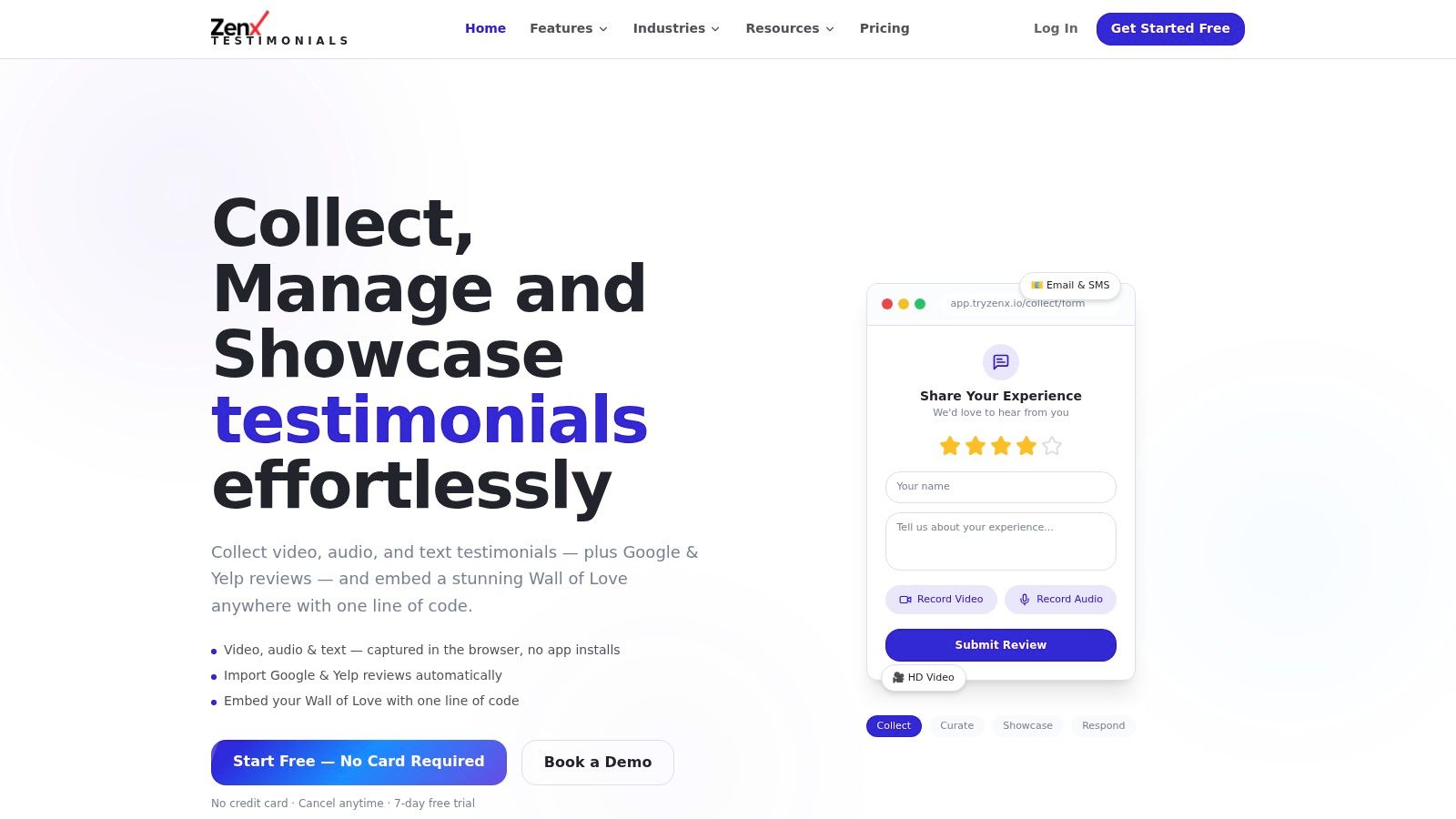
Frictionless collection beats feature overload
Video is often where testimonial collection flows fail. Customers click, hesitate, and abandon the process because the request suddenly feels more demanding than expected.
That is why browser-first capture matters. According to VideoTestimonials platform details on AlternativeTo, video testimonial platforms that use in-browser recording without app installs or user accounts can reduce submission barriers and improve participation. In practice, this is one of the most important variables a team can control.
A strong modern setup should allow the customer to:
- Open a link and record immediately without downloads
- Choose text, audio, or video based on comfort level
- Respond on mobile without friction
- Follow clear prompts so the testimonial is specific enough to publish
Unified proof is what saves team time
The second challenge is operational. Even when customers provide high-quality feedback, its value declines when it is distributed across too many systems.
Better products solve that problem with a unified dashboard that brings together first-party testimonials and third-party reviews. This gives the team one library to moderate, tag, filter, and publish from. It also makes it easier to align proof with the page or campaign where it will have the greatest effect.
This model is most effective when it includes:
- Imports from Google and Yelp so external proof is not isolated
- A central moderation view for approval and cleanup
- Embeds that install quickly without requiring a developer for every update
- Reusable widgets such as a wall, carousel, or grid that can be deployed across pages
If you want to see how this kind of workflow is typically structured in practice, the platform workflow overview is a useful reference.
The difference between a collector and a system
Teams do not need another place to store compliments. They need a functioning social proof engine.
That means one platform should support collection, organization, and publishing without turning every new request into a custom project. The products that perform best here are not always the ones with the longest feature list. They are the ones that reduce hesitation for the customer and repetition for the team.
Actionable Templates for High Response Testimonial Requests
Most testimonial requests underperform because they are too broad.
"Would you mind leaving us a testimonial?" sounds polite, but it creates unnecessary work for the customer. The customer must decide which format to use, what story to tell, and how much detail is expected. Strong templates remove those decisions.
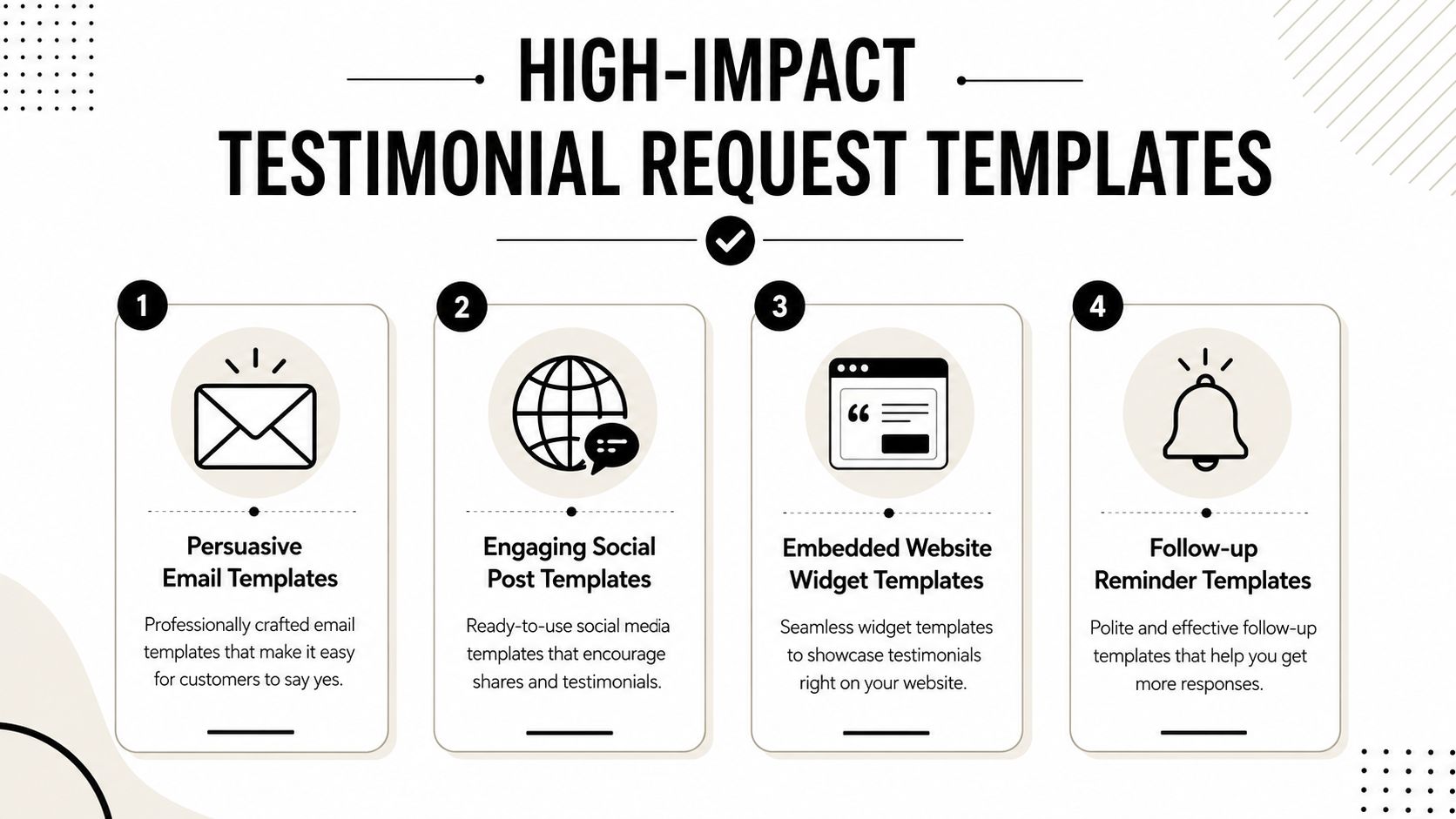
Copy and paste email template
Use this when the customer has just reached a positive milestone, renewed, or shared unsolicited praise.
Subject: Quick favor? Could you share your experience
Hi [First Name],
Thanks again for working with us. You've seen [specific outcome or use case], and I'd love to capture your experience in your own words.
If you're open to it, here's a quick link where you can leave a short testimonial in text or video: [link]
A strong response can be as simple as answering these:
- What problem were you trying to solve?
- Why did you choose us?
- What changed after you started using it?
It only takes a few minutes, and we'd really appreciate it.
Thank you,
[Name]
Why it works:
- It gives context instead of making a generic request
- It narrows the response with three prompts
- It offers format flexibility so the customer does not feel forced into video
Copy and paste SMS template
SMS is effective when the relationship is strong and timing matters. The message should remain brief.
Hi [First Name], thanks again for choosing us. Could you share a quick testimonial here? Text or video both work: [link]
Use SMS for local services, agencies, and post-purchase follow-up where email response times tend to lag.
A multi-channel approach matters because it allows businesses to meet customers where they already respond. According to Slashdot's Feedspace alternatives pricing roundup, platforms that improve response rates through Email, SMS, and QR codes offer a clear cost-benefit tradeoff, and tools like RatingE cost around $30 per month for that functionality.
Web form question set
A structured form is useful when customers need guidance but should not feel overburdened.
Use these fields:
- Name and role so the quote has attribution
- Company or context so readers understand relevance
- What problem were you facing? to surface pain points
- What nearly stopped you from buying? to reveal objections
- What changed after using the product or service? to surface outcomes
- Can we feature this on our website and marketing materials? to capture consent
Video prompt script
Customers often hesitate on video when they do not know how to begin. A prompt framework helps them respond naturally while staying specific.
Please answer any two or three of these in your own words:
What were you struggling with before?
Why did you choose us over other options?
What result or improvement stands out most?
Who would you recommend us to?
Field note: The best video prompts do not ask for praise. They ask for a before-and-after story.
Which channel fits which business
| Business type | Best primary channel | Good backup channel | What to ask for |
|---|---|---|---|
| SaaS | In-app link or follow-up from CSM | Problem, evaluation reason, result | |
| Ecommerce | Post-purchase email | QR code in packaging or SMS | Product fit, trust, delivery, outcome |
| Local service | SMS | QR code in-store | Experience, staff, convenience, trust |
| Agency or consultant | Personal email | Direct message after delivery | Before state, project impact, working style |
If you want more variations, these testimonial request email templates are useful as a swipe file.
Implementing Your First Campaign in ZenX
The fastest way to launch is to stop thinking in terms of "collect testimonials" and start thinking in terms of a campaign. A campaign has one audience, one ask, one preferred format, and one destination where the proof will be used.
That structure keeps the request focused and makes moderation easier later.
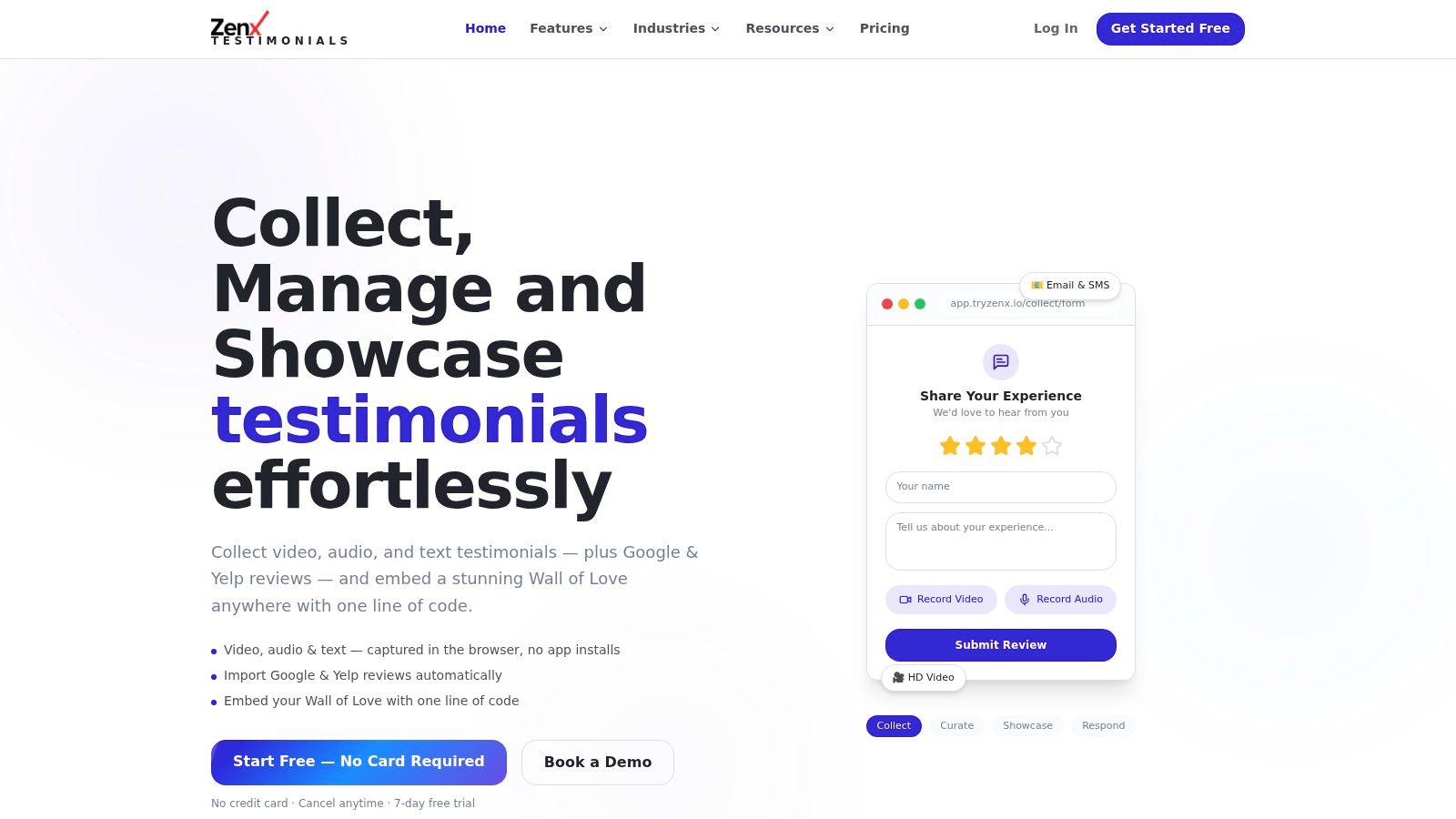
Step 1 Choose one use case
Do not begin with a master form intended for every customer type.
Build the first campaign around one clear objective. Strong examples include:
- Post-onboarding SaaS feedback for the homepage or pricing page
- Local service reviews after appointment completion
- Agency testimonials after project delivery
- Product-specific ecommerce feedback tied to a best-selling item
A narrow campaign usually produces stronger proof because every respondent is reacting to a similar experience.
Step 2 Build the request around the customer moment
The request should align with the moment when the customer is most satisfied and least distracted.
For SaaS, that is often immediately after activation, a successful support interaction, or a positive renewal conversation. For service businesses, it is right after the result is delivered. For ecommerce, it is after the customer has had enough time to use the product, not the moment it arrives.
Use the templates from the earlier section, but customize two details:
- Mention the specific outcome or milestone
- Limit the ask to a short response in one preferred format
Step 3 Brand the collection page lightly
This step is often overdone.
The page should feel legitimate, but it should not feel heavy. Keep the page simple: logo, short introduction, a sentence explaining how the testimonial may be used, and the prompt fields.
A lean structure usually performs best:
- Headline that states the request clearly
- One sentence of context tied to the customer experience
- Format choices such as text, audio, or video
- Prompt questions that guide specificity
- Consent checkbox for publishing
Step 4 Send through one primary channel first
If email is the primary channel, begin with email. If customers consistently reply faster by SMS, start there.
Consistency matters more than volume. Do not launch every channel at the same time unless the relationship justifies that level of outreach. Start with one send, then follow up with non-responders.
One strong request sent at the right moment usually performs better than three generic reminders sent too late.
Step 5 Moderate for usability, not perfection
Once submissions begin coming in, review them with publication in mind.
Look for testimonials that answer real buying questions. A short, direct response that explains why the customer chose you can outperform a longer quote filled with generic praise. Tag submissions by use case, product line, industry, or objection handled so the library becomes searchable later.
Step 6 Publish to one high-intent page first
Do not spread the first batch across the entire site. Place them where decision pressure is highest.
Strong initial placements include:
- Pricing pages
- Service landing pages
- Product detail pages
- Demo or trial signup pages
- Proposal and sales deck sections
This creates a useful feedback loop. It becomes easier to see which kinds of testimonials deserve greater collection volume.
Managing and Publishing Your Social Proof for Growth
A customer submits a strong quote on Tuesday. By Friday, sales still cannot locate it, marketing has not tagged it, and the website is still showing the same three testimonials it displayed last quarter. That is the gap between collecting proof and using it to influence conversion.
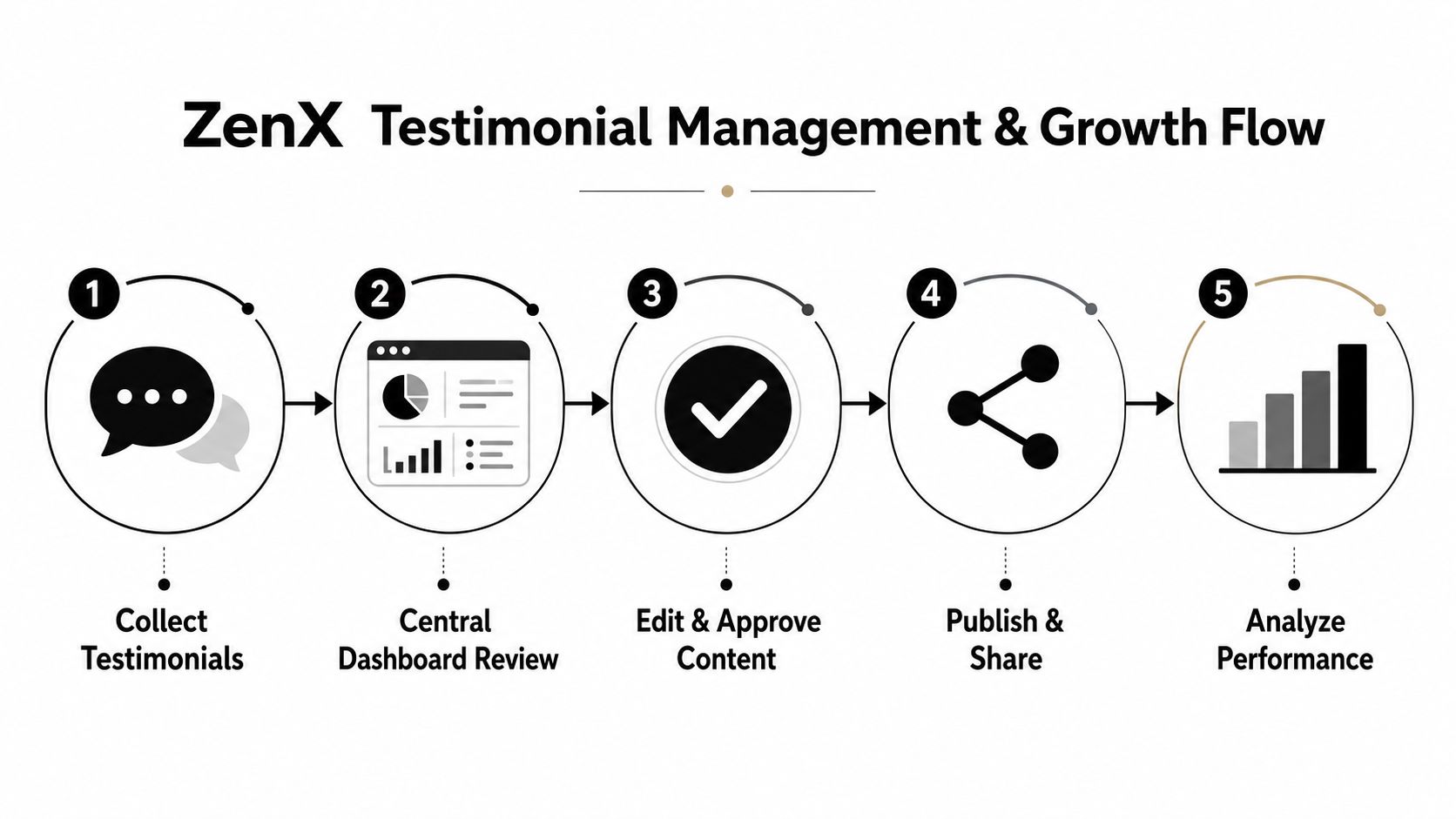
A useful system gives the team one operating layer for review, approval, tagging, and publishing. ZenX Testimonials is most effective when treated less like a form tool and more like a content pipeline. Every submission should either be published, repurposed, or archived for a clear reason.
What to manage before you publish
The review process should remain disciplined and repeatable:
- Approve for buying relevance by keeping testimonials that answer prospect questions
- Tag by commercial use such as industry, use case, feature, objection, persona, or funnel stage
- Edit lightly for readability while preserving the customer's meaning
- Archive overlap so published proof stays specific instead of repetitive
- Assign each testimonial to a destination such as pricing, product, service, retargeting, sales collateral, or case study preparation
Weak testimonial programs often fail at this stage. Teams collect quotes, publish a widget, and stop. The result looks active but contributes very little to pipeline.
The stronger approach is to build a proof library that can be sorted quickly. If a prospect in healthcare asks about onboarding speed, sales should be able to access three relevant customer quotes within minutes. If the paid acquisition team needs proof for a mid-funnel landing page, they should not have to search through raw submissions.
Turn testimonials into assets, not just page decoration
A testimonial should serve more than one purpose.
One short quote can strengthen a product page. A longer version of the same story can become a sales slide, founder post, nurture email, or case study draft. Video clips are especially valuable because one customer recording can be repurposed into homepage proof, paid social creative, and objection-handling snippets for SDR outreach.
Here is a practical way to manage that in ZenX:
| Asset type | Raw input | Published version |
|---|---|---|
| Homepage proof | Short text quote | Tagged quote block matched to ICP and offer |
| Sales enablement | Video clip or customer answer | Objection-specific proof library for reps |
| Case studies | Multiple answers from one customer | Structured story with problem, rollout, result |
| Competitive positioning | Repeated themes across testimonials | Messaging angles that highlight strengths buyers care about |
The trade-off is clear. More tagging and moderation work at the start creates faster reuse later.
Well-organized testimonials usually outperform larger, unstructured libraries. Volume helps, but retrieval matters more. If no one can find the right proof at the right moment, the library is only storage.
Publish based on intent
Publishing should follow page intent, not convenience.
A pricing page needs proof related to ROI, confidence, and purchase readiness. A service page needs proof about process, communication, and outcomes. A trial signup page needs concise credibility signals near the CTA. ZenX Testimonials is strong in this area because it allows teams to maintain one source library and publish curated sets rather than copying the same testimonials everywhere.
That also improves performance over time. Teams can rotate proof by page type, test different combinations, and learn which stories help more visitors convert. This is the element many feature-roundup articles overlook. The ultimate advantage is not simply choosing another tool. It is building a repeatable system that collects the right testimonial, routes it to the right page, and republishes it across the funnel with minimal manual effort.
SEO Legal and Industry Specific Guidance
Publishing testimonials without a few operating rules creates avoidable issues. The solution is not complicated, but it does require discipline.
Consent and compliance basics
Use a clear consent line on every form. Keep it simple and specific:
I agree that [Company Name] may publish my testimonial, name, company, and submitted media on its website and marketing materials.
If you serve regulated industries, ask legal counsel to review the wording, especially in healthcare, finance, or any context involving sensitive customer information. Teams should also avoid editing a quote so heavily that it changes the customer’s meaning.
SEO details that actually matter
If your testimonial widget is indexable and uses clean, structured markup, search engines can better understand the content on the page. That is one reason embedded social proof should live on your domain and fit naturally into the page, rather than sitting behind a clunky script experience that obscures the substance.
Keep these principles in mind:
- Place testimonials near decision points such as service sections, pricing, or CTAs
- Match testimonials to keyword intent so the surrounding page remains relevant
- Use attributed, specific language instead of anonymous, generic praise
- Avoid publishing the same block everywhere because repetition reduces usefulness
Industry-specific prompting
Different business models should request different kinds of proof.
- SaaS teams should ask about the workflow problem, buying hesitation, and the feature or outcome that mattered most.
- Local gyms, clinics, and service businesses should ask about trust, atmosphere, speed, staff, and overall experience.
- Agencies and consultants should ask about communication, delivery process, and the business context before and after the engagement.
- Ecommerce brands should ask about product quality, fit, ease of use, and whether the customer would recommend it.
A strong testimonial does not simply say that a business is good. It helps the next buyer make a decision.
If you want to replace a fragmented testimonial process with one system for collecting, organizing, and publishing social proof, ZenX Testimonials is built for that purpose. It helps teams capture video, audio, and text testimonials, import reviews from Google and Yelp, and turn customer feedback into assets that can be used across the site and marketing campaigns.
Written by
Sunil
ZenX Testimonials
Sunil writes about reviews, testimonials, and the everyday work of earning customer trust.