Top Testimonial.to Alternatives for 2026: A Full Guide
The best Testimonial.to alternatives for 2026 compared on video collection, widgets, review imports, and pricing to find the right fit.
In this article
- Why Marketers Are Searching for Testimonial.to Alternatives
- Beyond the Wall of Love The Limits of Basic Testimonial Tools
- Evaluating Modern Social Proof Platforms Key Criteria for 2026
- ZenX Testimonials vs Testimonial.to A Head to Head Comparison
- High Conversion Feedback Forms Templates and Best Practices
- Choosing Your Next Testimonial Platform and Making the Switch
Customer testimonials remain one of the most effective forms of social proof. Most teams do not start evaluating Testimonial.to alternatives because testimonials no longer matter. They start evaluating alternatives because the broader workflow around collecting, managing, and deploying customer feedback becomes more complex over time.
That inflection point is common. A business may have several strong customer videos stored in one platform, Google reviews managed elsewhere, Yelp feedback monitored inconsistently, and website testimonials displayed in a polished Wall of Love. On the surface, the brand looks credible. Operationally, however, review and testimonial management is fragmented across multiple tools, inboxes, and spreadsheets.
That fragmentation creates immediate costs. Marketing teams want faster publishing workflows. Customer success teams need a more reliable way to request reviews. Local teams need visibility into Google reviews. Leadership wants clarity on which themes customers consistently praise, and where competitors are earning stronger sentiment.
Why Marketers Are Searching for Testimonial.to Alternatives
Testimonial.to established itself as a credible option in this category. It simplified the process of collecting text and video testimonials, packaging them into embeddable widgets, and publishing social proof without a complex implementation cycle. It also demonstrated that a streamlined testimonial product could support a meaningful business. Testimonial.to was built by indie developer Damon Chen and reached over $100,000 in monthly recurring revenue as a solo operator, a strong signal that lightweight testimonial software solved a real need in the market, as covered by Tiny Startups' profile of Testimonial.to.
That success helps explain why many teams begin there.
The challenge typically appears later. A startup adds Google review collection for sales conversations. An agency requires separate visibility across client accounts. A local business wants a single system to monitor incoming feedback and decide what should be showcased publicly. The testimonial platform may still perform its original function well, but the surrounding workflow begins to break down.
The search is usually about consolidation
Many businesses are not abandoning testimonial collection. They are trying to unify social proof operations.
A common scenario looks like this:
| Workflow need | What happens with a basic tool |
|---|---|
| Collect a customer quote | Easy |
| Publish a widget on the site | Easy |
| Monitor Google reviews daily | Separate workflow |
| Reply to public reviews quickly | Separate workflow |
| Compare your review themes against competitors | Usually unavailable |
| Route positive reviews to public channels and keep negative feedback private | Often manual |
That is why interest in testimonial.to alternatives continues to grow. The central question is not, “How do I collect one more quote?” It is, “How do I manage reputation, testimonials, and review intelligence from one place without adding more manual work?”
Teams outgrow simple testimonial software when social proof stops being a design asset and becomes an operating system for marketing, sales, and reputation management.
Beyond the Wall of Love The Limits of Basic Testimonial Tools

A Wall of Love still serves an important purpose. It provides buyers with a quick trust signal, performs well on landing pages, and helps teams repurpose customer feedback without requiring custom design resources. If that is the only objective, a lightweight platform may be sufficient.
The friction begins when a testimonial platform is expected to do more than display approved praise.
Collection is only one part of the job
First-generation testimonial tools are designed around a narrow cycle. Request feedback. Review it. Publish it. That model works for founder-led SaaS companies, creator businesses, and relatively simple product pages.
It becomes less effective when proof exists across multiple channels.
Google reviews often carry more weight than submitted testimonials for local businesses and service-based categories. Product reviews may live inside an ecommerce stack. Sales teams may need proof tailored to a specific use case for outbound efforts. Support teams may want to trigger requests after a resolved ticket. A basic widget library does not solve that level of orchestration.
Even the display layer can become restrictive. A single gallery format may look polished initially, but different pages require different proof formats. Homepage trust bars, product-page snippets, carousels, comparison-page quotes, and dedicated review hubs each serve distinct purposes. That is where a more flexible Wall of Love display approach becomes relevant.
Manual review operations do not scale well
The larger issue is operational. As feedback volume increases, manual curation begins to consume disproportionate time.
This typically shows up in several ways:
- Review monitoring becomes fragmented. One person checks Google, another exports testimonials, and no one has a complete view.
- Approval workflows become reactive. Testimonials remain unpublished because there is no clear moderation process connected to the channels that matter most.
- Follow-up logic remains simplistic. Teams continue sending the same request flow to every customer instead of adapting based on rating, sentiment, or source.
- Insights remain shallow. The team knows which reviews are positive, but not which themes recur or where competitors are earning credit.
Practical rule: If your team still has to copy reviews from one system into another, your testimonial stack is not complete.
Basic tools rarely support strategic review use cases
Modern platforms increasingly differentiate themselves because social proof is no longer just website content. It is also a strategic source of customer and market insight.
If your software cannot help answer questions like these, it is already behind your needs:
- What objections consistently disappear after buyers read reviews?
- Which customer phrases should be reflected on landing pages?
- What themes appear in competitor reviews that your brand can target?
- Which dissatisfied customers should be redirected into private feedback before reaching a public posting step?
These are not design problems. They are workflow and intelligence problems.
That is also the limitation of many Testimonial.to alternatives. Some improve on pricing or widget design, but still stop at collection and display. If your team has outgrown Testimonial.to, replacing it with another surface-level tool often just shifts the bottleneck.
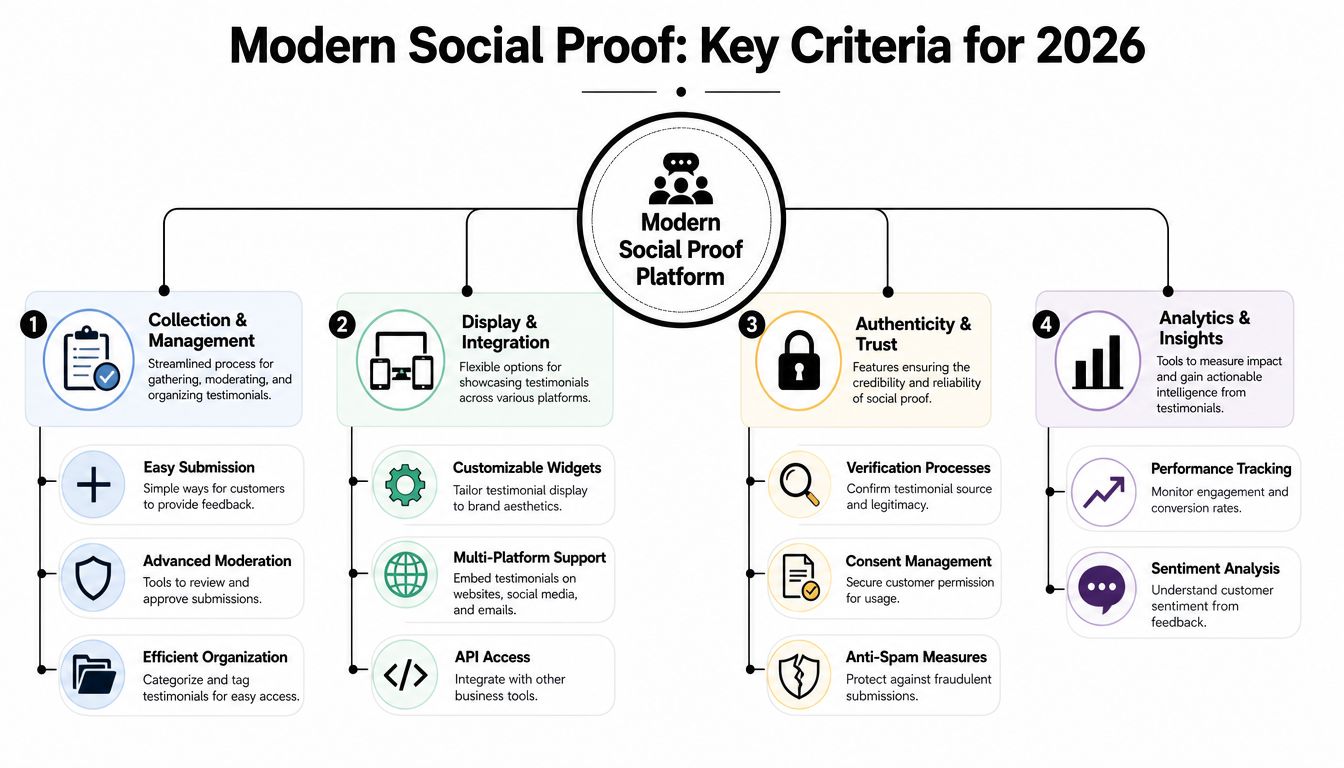
Evaluating Modern Social Proof Platforms Key Criteria for 2026
A marketing team sends a review request after onboarding. The customer opens it on a phone between meetings, partially completes the form, then abandons it. Later, someone on the team has to follow up, copy a separate Google review into a spreadsheet, and manually decide whether any of that content belongs on a landing page. That workflow remains common, and it explains why evaluation criteria have changed.
The standard for 2026 is higher than collection and display. The most useful platforms now combine feedback capture, review operations, publishing, and analysis in a single system. That shift matters because social proof is no longer just a website asset. It informs conversion optimization, retention messaging, local reputation, and competitive positioning.
Unified review management
Start with the operating model. Can the platform manage first-party testimonials and third-party reviews within the same workflow?
That means more than importing a few public quotes. It means the marketing lead, customer success manager, and location owner can all work from one dashboard, with shared visibility into requests, approvals, published assets, and response history. After switching to ZenX, this was the first meaningful improvement I noticed. We stopped treating testimonials as a separate content initiative and began managing them as part of ongoing review operations.
A platform should support:
- Direct collection through text, audio, or video forms
- Connected review sources from the channels buyers already check
- Central moderation so approvals, routing, and publishing happen in one place
- Role-based access for teams that share ownership across marketing, CX, and local operations
That structure reduces handoffs, which is often where social proof programs slow down.
Automation that reduces manual work
Automation only matters when it removes repetitive work that teams already struggle to manage.
The most useful automation handles request timing, follow-up logic, moderation queues, and review routing based on the actual response. A positive submission can move toward a public review request or testimonial use. A dissatisfied response can be routed into a private service recovery flow. That is an operational improvement, not just a feature checklist item.
If you are comparing tools, a detailed ZenX vs Testimonial.to platform comparison becomes practical. The relevant question is not whether a platform can send a request. It is how much work still falls to your team after the request is sent.
AI-driven insight that improves messaging
This is the next major frontier, and many basic alternatives still fall short.
Collecting testimonials is useful. Understanding them at scale is more valuable. Strong platforms help teams group recurring themes, identify sentiment shifts, surface the phrases customers naturally use, and detect patterns in competitor reviews that can inform positioning. That transforms review content from a widget feed into a source of strategic intelligence.
I look for AI that helps answer decisions a strategist actually needs to make:
- Which proof points belong on high-intent pages?
- Which objections are fading after prospects read reviews?
- Which customer phrases should appear in ads, emails, or sales enablement?
- Which negative responses require fast human intervention instead of auto-publishing logic?
If the AI simply rewrites a quote summary, the business impact is limited. If it helps a team identify patterns and act on them, it improves conversion work and reduces research time.
Display, trust, and implementation quality
Design still matters, but it should be evaluated in context. The right platform needs flexible widgets, responsive embeds, clear consent handling, spam controls, and transparent sourcing. Those details affect legal risk, credibility, and how much cleanup your team has to do later.
It is also worth testing the implementation from the buyer’s point of view. Open the form on mobile. Submit a video. Review the moderation flow. Check how quickly approved content can move to a page without developer support. A polished demo matters less than a platform your team will use consistently.
The strongest platforms for 2026 perform four functions well. They collect feedback, manage reviews, surface insight, and publish proof without pushing teams back into spreadsheets and copy-paste workflows.
ZenX Testimonials vs Testimonial.to A Head to Head Comparison
A common breaking point looks like this. The team has testimonials embedded on the site, Google reviews open in another tab, support feedback stored in a form tool, and a marketer manually copying strong quotes into landing pages. Testimonial.to addresses the first part effectively. It does not solve the broader operating model around the rest.
That is the central difference between these products. Testimonial.to is built for collecting and displaying testimonials. ZenX is built for teams that want testimonials, public reviews, routing, moderation, and analysis in one place. If you are evaluating the trade-offs, this side-by-side ZenX vs Testimonial.to comparison is a useful starting point.
| Area | Testimonial.to | ZenX Testimonials |
|---|---|---|
| Core use case | Collect and publish text and video testimonials | Manage testimonials and third-party reviews in one workflow |
| Google My Business handling | Import-oriented workflow | Native account linking and ongoing management workflow |
| Dashboard model | Testimonial-focused | Centralized review and testimonial operations |
| Review routing | More manual curation | Automated routing for public vs private feedback |
| AI usage | Limited in this comparison context | Sentiment analysis, draft replies, competitor review analysis, review chat workflow |
| Strategic insight | Primarily display-focused | Review intelligence plus publishing |
Unified dashboard and Google My Business integration
I outgrew testimonial-first tools.
Once a company needs to manage local search, sales proof, and review response times at the same time, a standalone testimonial platform creates additional administrative work. Testimonials may be organized, but the broader customer proof stack remains fragmented. ZenX pulls reviews and testimonials into one dashboard, including Google review operations through ZenX Google review management.
The practical benefit is straightforward. Marketing, customer success, and whoever owns review response can work inside the same system instead of passing screenshots and links around Slack. That reduces missed reviews, duplicate follow-ups, and the delay between a strong customer comment and that proof appearing on a revenue-generating page.
Testimonial.to can still fit a narrow use case. A founder who only wants a clean Wall of Love may not need more. The gap appears when proof has to be collected, approved, responded to, and reused across channels every week.
Advanced automation and review routing
Review routing is one of the clearest workflow differences.
With Testimonial.to, teams often sort submissions manually, decide what to publish, and handle dissatisfied responses outside the platform. ZenX adds an operational layer. Incoming feedback can be routed toward public review requests or held privately for follow-up, which gives teams more control over what becomes social proof and what becomes a service recovery task.
ZenX also supports Google Review Alerts, which surfaces new reviews quickly with sentiment analysis and draft replies. That matters less for a static testimonial gallery and much more for businesses where response speed affects trust, local visibility, or account retention.
The result is fewer copy-paste steps and faster action. For a lean marketing team, that is often the difference between collecting feedback and actually using it.
AI-powered insights and competitor analysis
This is the next category shift. Collection is now table stakes. The more important question is whether the platform helps the team learn something useful from the feedback it already has.
ZenX goes further than storing approved quotes. Its AI layer helps teams examine review themes, identify sentiment patterns, draft responses, and analyze competitor reviews for repeated strengths or complaints. That turns social proof into a research input.
I find this especially valuable for message testing. If competitor reviews repeatedly praise fast onboarding, weak handoff support, or transparent pricing, marketing can adjust page copy and sales enablement around those patterns. If your own reviews show that buyers consistently mention responsiveness or ease of setup, those phrases can be incorporated into ads, email, and demo follow-ups with much less guesswork.
A basic testimonial tool gives you a library. An integrated platform gives you a feedback system.
Design flexibility and pricing trade-offs
Testimonial.to still offers a genuine advantage in simplicity. It is easy to understand, quick to launch, and focused on publishing testimonials without substantial operational overhead. For some teams, that is enough.
The trade-off is that you may save time during setup and lose time every week afterward. If reviews live elsewhere, if routing is manual, and if insight extraction depends on someone reading everything individually, the lower-complexity product can create a more complex workflow.
Pricing should be evaluated against that reality, not against widget count alone. As noted earlier, there are cheaper tools for basic display use cases. The stronger case for ZenX is not that it replaces one testimonial widget with another. It replaces a patchwork of review monitoring, manual moderation, response drafting, and quote harvesting with one operating system for social proof. For a team that already treats customer feedback as a conversion and retention asset, that is often the stronger long-term value.
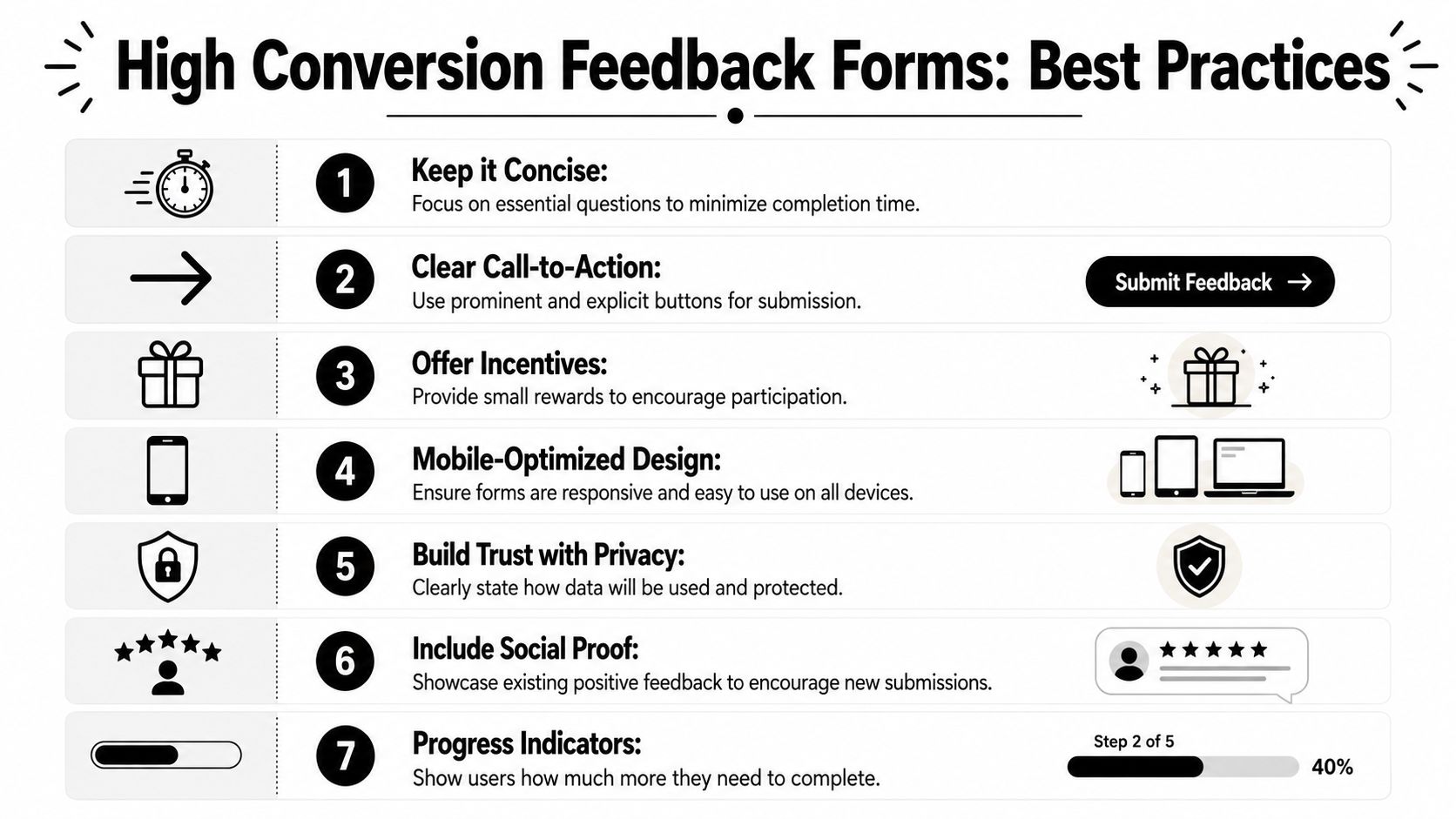
High Conversion Feedback Forms Templates and Best Practices
The platform matters, but form design still determines whether customers respond. Submissions are often lost because requests are poorly timed, ask too much, or force respondents into a rigid format.
A better approach is to align the form with the customer’s context.
Post-purchase form
Use this when the customer has just had a successful buying or delivery experience.
Recommended fields
- Rating prompt with a simple satisfaction question
- One open text field asking what stood out
- Permission checkbox for publishing
- Optional photo or video upload for stronger social proof
Example copy
“Thanks for your order. What almost stopped you from buying, and what made you feel confident after using us?”
That question works because it surfaces both objection and outcome. Those are the two elements marketing teams need most.
Support follow-up form
This format works well after a resolved support issue, onboarding milestone, or completed service request.
Try this structure:
| Field | Purpose |
|---|---|
| What issue were you facing? | Captures the before state |
| How was it resolved? | Gets specific proof |
| Would you recommend us? | Gauges advocacy |
| Can we feature this feedback? | Clears usage rights |
Keep the layout short and mobile-friendly. That matters because many customers will open the request from email on a phone.
Video or audio capture form
Video requests should feel lighter than most teams expect. Do not begin with a blank record button and no context. Add a short prompt with two or three suggested talking points.
Useful prompts include:
- What problem were you trying to solve?
- What changed after using the product or service?
- What would you tell someone considering it?
If you are building these workflows in a tool with conditional logic and branded collection pages, smart testimonial forms make it easier to reduce friction while still collecting structured answers.
Field note: The highest-performing forms usually feel like a guided conversation, not an application form.
Best practices that improve quality
A few habits consistently improve form performance:
- Ask close to the moment of value. Do not wait until the customer has forgotten the positive outcome.
- Give one primary action. If the form asks for text, video, photo, and referral details all at once, completion rates will drop.
- Use prompts that create contrast. “What changed?” is stronger than “Share your thoughts.”
- Pre-plan where each answer will go. Short quotes belong on product pages. Detailed stories belong in case studies. Video clips belong in sales and paid social.
- Learn from market language. ZenX's competitor analysis feature clusters public competitor reviews to reveal strengths and gaps, which helps teams shape form prompts around the issues buyers already care about, as noted on the ZenX platform overview.
Good forms do not just collect praise. They collect usable proof.
Choosing Your Next Testimonial Platform and Making the Switch
If your needs are still straightforward, Testimonial.to can remain a practical option. It is effective for collecting testimonials quickly and turning them into site-ready proof.
However, if your team is juggling Google reviews, testimonial requests, public review responses, and messaging research across multiple systems, you have already outgrown that model. At that point, the stronger choice is a platform designed around a unified dashboard, automation, and review intelligence.
The most practical reason to switch is operational clarity. You want one place to collect feedback, moderate it, decide what becomes public, and extract messaging insights without exporting data between tools.
What to prioritize during the move
Use a short migration checklist:
- Audit your sources. List where proof currently lives, including direct testimonials, Google, Yelp, and any legacy widgets.
- Define publishing rules. Decide what belongs on landing pages, what remains private, and who approves what.
- Set up automated requests. Trigger requests after purchase, onboarding completion, or support resolution.
- Train around one dashboard. The workflow only improves when the team stops relying on five different tools.
One capability matters more than it may seem during the transition. ZenX automatically routes 5-star reviews to Google and Yelp while collecting private feedback from unsatisfied customers, which creates a cleaner public proof pipeline and reduces the risk of exposing negative feedback on widgets, according to ZenX features.
That kind of routing changes the process from manual curation into managed reputation flow.
The real upgrade is not the widget
Teams often assume they are replacing testimonial software. In reality, they are replacing a fragmented process.
A stronger platform gives marketing cleaner proof, gives operations fewer moving parts, and gives leadership a clearer understanding of what customers value. That is why the best testimonial.to alternatives are not simply cheaper or more attractive. They unify collection, review management, automation, and insight in a way basic tools do not.
If you want a more integrated way to collect testimonials, manage Google and Yelp reviews, automate follow-up, and turn customer feedback into usable marketing insight, take a look at ZenX Testimonials. It is a practical next step for teams that have moved beyond simple testimonial widgets and need one system for social proof operations.
Written by
Sunil
ZenX Testimonials
Sunil writes about reviews, testimonials, and the everyday work of earning customer trust.