10 Best Birdeye Alternatives for 2026
Compare 10 Birdeye alternatives for 2026 on review management, testimonials, pricing, and fit for small businesses and multi-location brands.
In this article
A lot of Birdeye evaluations stall at the same point. The demo looks polished, the feature list is long, and then the question shows up. Does your team need a broad reputation platform, or do you need one part of it done better?
I've seen that split play out across very different teams. A home services brand usually cares about fast review requests, texting, and location-level follow-up. A SaaS company often gets more value from collecting customer stories it can publish across landing pages and sales collateral. Agencies tend to care about account structure, reporting, permissions, and whether the platform is practical to run across dozens of clients.
That is the frame for this guide. It is not a generic feature checklist. It groups Birdeye alternatives by the type of business they fit best, because the right choice depends on your operating model more than headline feature count.
Birdeye remains a credible option for review management, messaging, and customer experience workflows. The trade-off is scope. Some teams end up paying for modules they barely touch, while others want stronger testimonial collection, simpler day-to-day workflows, or better support for multi-location and multi-client setups. If you want a narrower tool with a clearer job, options like ZenX vs Birdeye for testimonial-focused teams are worth comparing early instead of treating every product as a direct like-for-like replacement.
The market is crowded, but the categories are not interchangeable. Trustpilot dominates public-facing review presence. Podium is often shortlisted by local service businesses that rely on SMS. Other platforms are better suited to agencies, e-commerce brands, or teams that care more about first-party proof than marketplace reviews.
The alternatives below are the ones worth serious consideration for 2026, based on the job each platform does best.
1. ZenX Testimonials
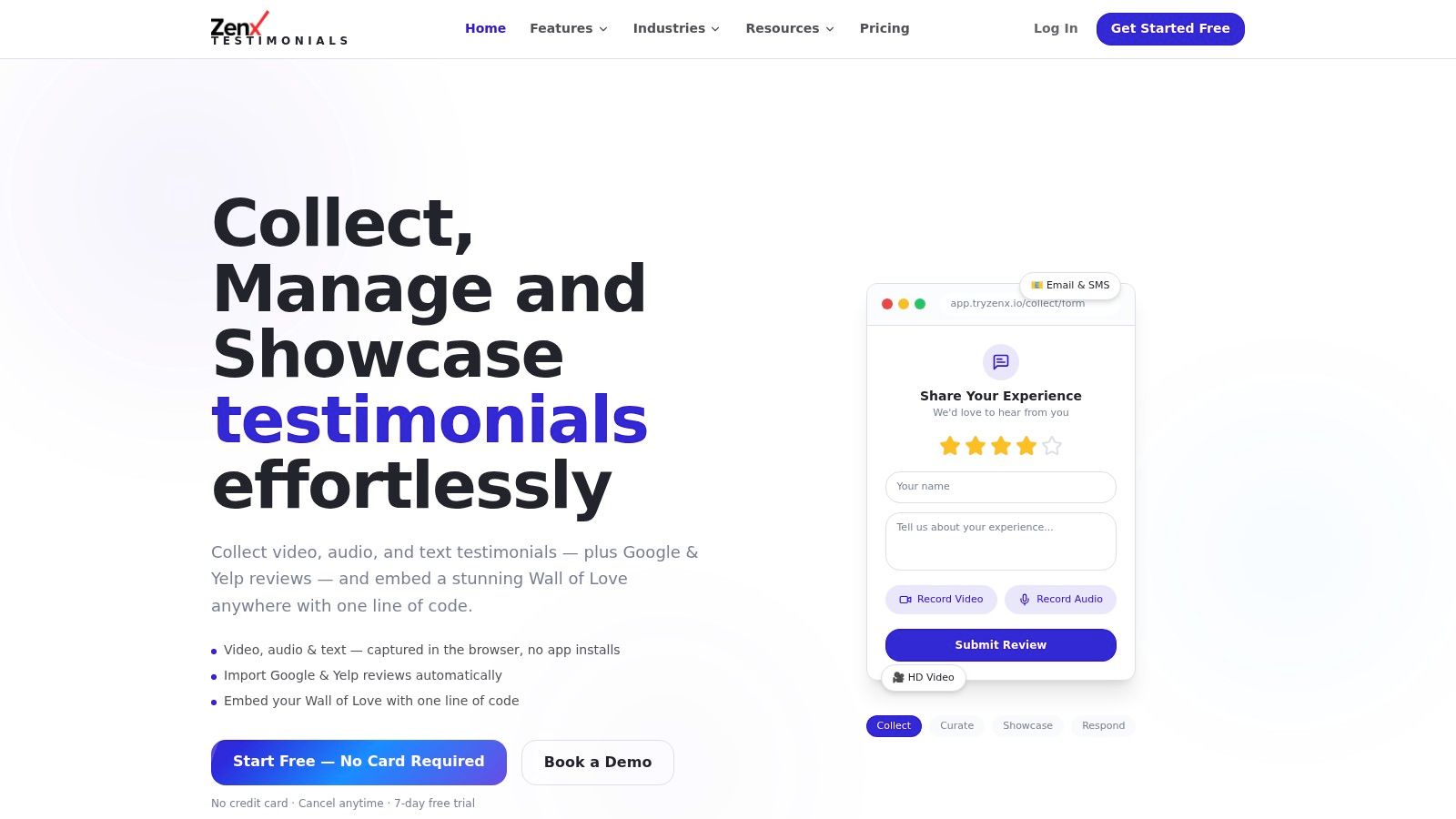
ZenX Testimonials is the one I'd put in front of teams that care less about broad reputation monitoring and more about turning customer feedback into usable conversion assets. That distinction matters. Many Birdeye alternatives focus on collecting and replying to reviews across public platforms. ZenX leans hard into first-party social proof, especially video, audio, and structured testimonials you can publish fast.
That makes it a better fit for SaaS, e-commerce, agencies, healthcare groups, and service businesses that want more than a star rating. It's built for the point after collection, when marketing needs to curate proof, tag it, embed it, and reuse it without dragging in engineering.
A quick product comparison helps frame the difference with ZenX vs Birdeye.
Best for video-first social proof
The biggest strength is low-friction capture. ZenX records HD video and audio directly in the browser, so customers don't need an app, login, or extra setup. That matters because friction kills response rates, especially when you're asking a happy customer to record something on the spot.
That browser-based model lines up with a broader shift in testimonial software. Modern platforms now support video capture from desktop or mobile without app installation, and distribute collection links through email, SMS, WhatsApp, or QR codes. ZenX applies that well in practice.
Practical rule: If your team needs testimonials for landing pages, ads, sales decks, and nurture emails, pick a tool that treats capture and publishing as one workflow. Don't bolt together forms, cloud storage, and a widget later.
Where ZenX stands out
- In-browser collection: HD video, audio, and text submission happen in one branded flow, which keeps the ask simple for customers.
- Publishing speed: The Wall of Love embeds are one-line installs and work in grid, carousel, and masonry layouts.
- Unified proof library: Google and Yelp reviews can be pulled into the same searchable dashboard as original testimonials.
- Operational support: AI moderation, smart tags, filters, bulk actions, and case study generation reduce manual curation work.
- Portability: Export capability matters if you don't want your best customer proof trapped inside one vendor.
Another practical advantage is support. Fast human help is underrated in this category because onboarding usually breaks on small implementation details, not strategy.
The trade-off is pricing transparency. ZenX is free to start and offers a trial, but detailed plan terms aren't fully public, so teams that need procurement-ready pricing up front may have to go through signup or sales. Also, Google and Yelp imports always depend on third-party platform policies, so any workflow tied to those sources should be tested early.
2. Podium
Podium is the Birdeye alternative I'd shortlist first for local service businesses that already live in text messaging. If your front desk, sales coordinator, or location manager is handling leads and follow-ups through SMS all day, Podium feels more natural than tools that treat messaging as an add-on.
That matches how it's often evaluated in market roundups. In an assessment of 15 BirdEye alternatives for 2026, Podium was identified as the strongest competitor for local service businesses because it combines review management, customer messaging, webchat, and payments in one system.
If reviews are tightly connected to lead response and payments in your workflow, Podium makes sense. If not, it can feel like buying a heavier platform than you need.
For teams trying to tighten local review operations, I'd also look at proven Google review management workflows before committing to a broad suite.
Best for SMS-centric local operations
Podium's core value is speed. Review requests, reminders, replies, webchat messages, calls, and social conversations can sit in one inbox, which reduces handoffs. That's useful for auto, dental, home services, med spa, and retail teams where the same employee often handles multiple customer touchpoints.
The upside is obvious when a business wants one tool to support acquisition and reputation together. The downside is just as obvious. Businesses that only need review collection may never use enough of the communications stack to justify the complexity.
Podium works best when the review ask is part of a live customer conversation, not a separate marketing campaign.
A few practical takeaways:
- Best fit: Local merchants, multi-location service brands, and operators with text-heavy workflows.
- Strong point: AI-assisted replies and review invitations reduce repetitive admin work.
- Watch out for: Sales-led pricing and a broader feature set than many small teams need.
3. NiceJob
NiceJob is a good answer for small and mid-sized local businesses that want momentum fast without a long setup cycle. It doesn't try to be the deepest enterprise platform in the room. That's part of its appeal.
The product is oriented around practical review generation, referral nudges, and social-proof widgets. For many local brands, that's enough to create a repeatable reputation engine without turning the software into its own project.
Best for SMBs that want fast wins
What NiceJob does well is reduce decision fatigue. Automated email and SMS requests, follow-ups, AI reply assistance, referral campaigns, and website widgets are straightforward to configure. Teams that don't have a dedicated marketing ops owner usually do better with a tool like this than with a platform full of governance layers they won't maintain.
It's also a better fit than Birdeye when the goal is simple growth, not broad multi-location oversight. A local roofer, dental office, or cleaning company often needs more reviews, stronger trust on the website, and a referral loop. NiceJob is built around that motion.
If your social proof strategy is expanding beyond public reviews into owned-site assets, it's worth comparing NiceJob against dedicated testimonial software options.
What works and what doesn't
- What works: Quick setup, clear automations, and an easy path from review collection to on-site display.
- What doesn't: Less suitable for businesses with strict brand controls across many locations or advanced listing governance.
- Who should pick it: SMBs that need more reviews and referrals without enterprise overhead.
NiceJob is one of the easier Birdeye alternatives to recommend because its scope is narrow enough to stay useful. That restraint usually ages well.
4. Trustpilot (Business)
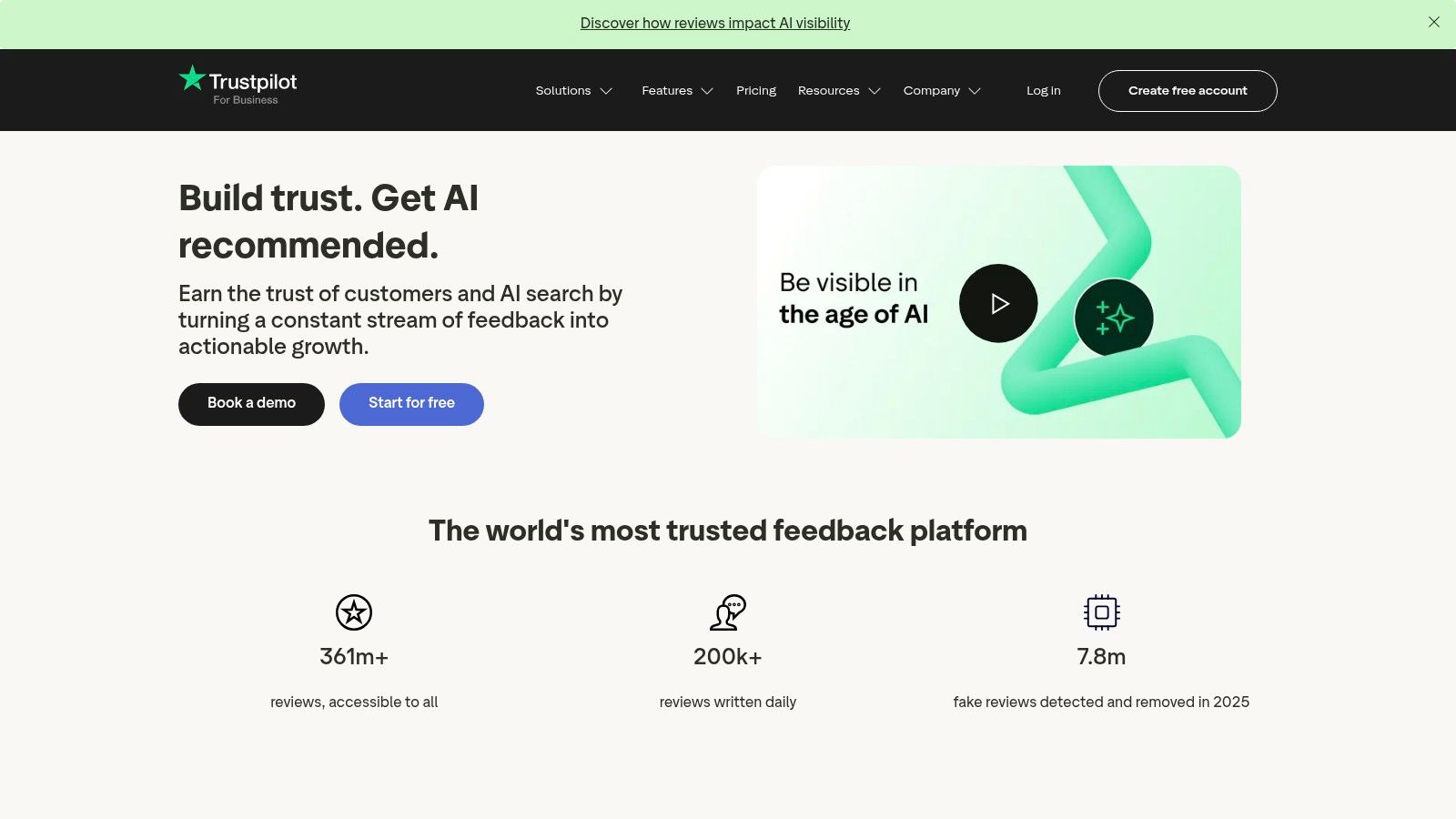
A shopper searches your brand, sees your site, then sees your Trustpilot score beside it. That second touch matters, especially for companies that sell online and need trust before a visitor ever fills out a form or starts checkout.
Trustpilot Business sits in a different category from Birdeye, NiceJob, or GatherUp. It is not only review management software. It is also a public review destination with consumer recognition. For some businesses, that public layer is the whole reason to buy it.
Best for e-commerce, SaaS, and online-first brands
Trustpilot is strongest when review visibility outside your own website matters as much as collection. E-commerce teams use it to support conversion. SaaS teams use it to reduce perceived risk during evaluation. Brands with national or international reach often value the fact that prospects already know what Trustpilot is, which lowers the trust gap faster than an unknown widget on a homepage.
That is the key use-case difference in this guide. If you run a local service business, a tool focused on first-party review generation may be the better fit. If you run an online brand and want reviews to work across search, paid traffic, partner research, and on-site proof, Trustpilot deserves a serious look.
The product itself covers the basics well: automated invitations, profile management, website widgets, trust badges, and integrations with common e-commerce platforms. Setup is usually straightforward. The harder part is deciding how comfortable you are building part of your reputation program inside someone else's ecosystem.
The practical trade-off
Trustpilot gives you reach and recognition. It gives you less control over the overall experience than a tool built around owned testimonials and first-party presentation.
That trade-off is not theoretical. Teams often like Trustpilot because buyers recognize the brand and trust the score format immediately. The friction shows up later in commercial terms, branding limitations, and the fact that your strongest proof assets live partly on a third-party platform rather than entirely on properties you control.
- Best fit: E-commerce brands, SaaS companies, and online-first businesses that need public trust signals.
- Strong point: High consumer recognition, plus mature widgets and review display options.
- Main caution: Better for platform visibility than full ownership of the collection and publishing workflow.
Trustpilot is one of the clearest Birdeye alternatives for businesses that want public credibility at scale. It is a weaker fit for teams that want tighter control over how reviews are captured, packaged, and reused across owned channels.
5. Reputation (Reputation.com)

Reputation.com is built for organizations that need structure. Not convenience. Structure. That means enterprise workflows, cross-location consistency, listings management, surveys, analytics, and policy control.
For a regional healthcare group, franchise network, or multi-brand operator, those things matter more than a sleek setup experience. For a ten-person business, it can feel oversized fast.
Best for enterprise and multi-location governance
The strongest case for Reputation is operational control at scale. You get review collection and response management, listings administration, survey capabilities, reputation analytics, and add-ons for managed services or deeper insight layers. Teams with central marketing and distributed locations usually understand the value immediately.
The friction is that you need enough internal process to justify it. Tools in this class are only effective when someone owns standards, routing, access, and reporting.
If your business has location managers, compliance requirements, and executive reporting, Reputation fits. If one office manager handles everything, it probably doesn't.
A few realities to keep in mind:
- Strong point: Deep analytics and enterprise workflows for larger organizations.
- Best fit: Multi-location brands with real governance needs.
- Watch out for: Feature breadth can exceed what SMB teams will ever use, and add-ons can change the total spend materially.
Reputation is one of the more serious Birdeye alternatives when your org chart is complex and local reputation affects many stakeholders.
6. ReviewTrackers (by InMoment)
ReviewTrackers is a good middle ground for teams that care about monitoring and reporting more than they care about bundling every customer communication channel into one product. It feels narrower than Birdeye and more focused than broader SMB growth suites.
That focus is useful. In practice, many companies don't need another inbox. They need cleaner visibility into review volume, sentiment, alerts, and competitor patterns.
Best for monitoring-heavy teams
The platform centralizes reviews from a wide range of sources, sends alerts, supports request workflows, and layers in AI response suggestions and competitor insights. This makes it especially workable for marketing teams that report on reputation trends across multiple locations but don't want the overhead of a huge all-in-one stack.
Its dashboards are one of the better parts of the experience. Non-specialists can usually understand what needs attention without much training, which helps with adoption.
Where it fits
- Best fit: Multi-location operators that want review monitoring, alerts, and reporting without heavy platform bloat.
- Strong point: Role-friendly dashboards and useful competitor visibility.
- Limitation: Deeper experience-management features and surveys sit higher up the stack.
ReviewTrackers is often the right answer when Birdeye feels too broad and a basic widget tool feels too small.
7. GatherUp
GatherUp has always felt practical to me. It doesn't try to win on polish alone. It wins by being usable for SMBs, agencies, and franchises that need reviews, surveys, widgets, and sensible multi-location workflows.
That matters because many reputation tools either over-serve enterprise buyers or under-serve agencies. GatherUp lands in a useful middle.
Best for agencies and franchise-style rollouts
Email and SMS requests, NPS surveys, QR codes, widgets, automations, API access, and white-label options give agencies plenty to work with. Franchises also get a platform that can scale across locations without forcing an enterprise buying process from day one.
The pricing approach tends to be easier to model than sales-led products. Included message volume and straightforward packaging make it simpler for operators to estimate cost before they're deep into procurement.
A utilitarian interface is often a good sign in operations software. It usually means the team prioritized workflows over demos.
What to expect
- What works: Agency-friendly controls, exports, practical widgets, and rollout simplicity.
- What doesn't: The interface is more functional than flashy, and advanced defense or listings features come through add-ons.
- Best fit: Agencies, franchises, and SMBs that care about reliable execution more than presentation.
GatherUp is one of the more balanced Birdeye alternatives for teams that need to do real work across several locations or clients.
8. Grade.us (by Traject)
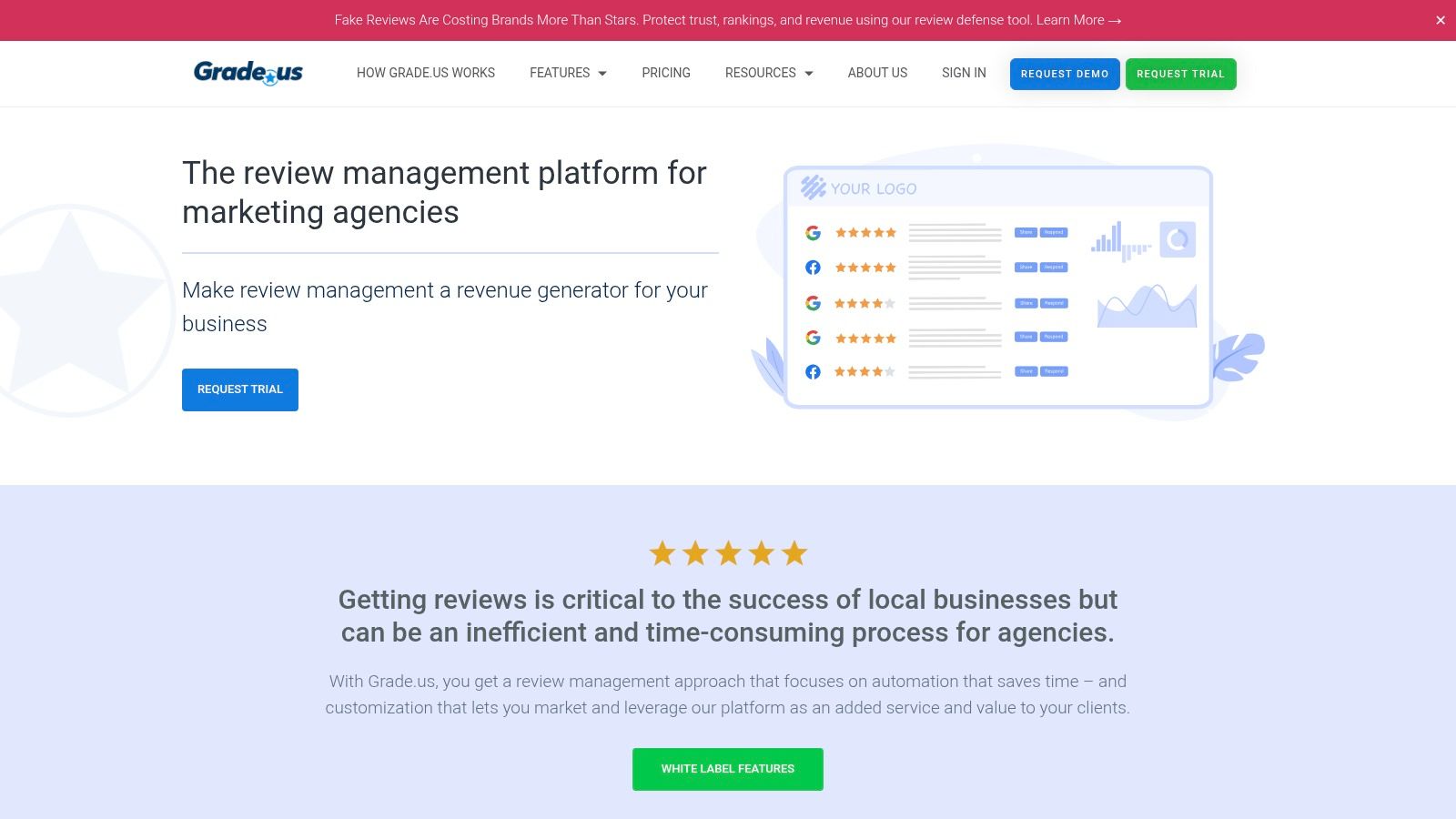
Grade.us is for agencies. That's the headline. Not “agencies can use it.” Agencies are the core use case.
If you package reputation management as a service, white-labeling and client management architecture matter more than glossy end-user UX. Grade.us understands that better than most.
Best for agencies and resellers
The review funnels, monitoring, replies, embeddable streams, schema options, API access, bulk CSV tools, WordPress support, and white-label controls are built for repeatable client operations. Agencies that manage many accounts need exactly this kind of infrastructure.
A lot of Birdeye alternatives can serve agencies. Fewer are set up for agencies to resell the service cleanly under their own brand.
The trade-off is obvious
- Strong point: White-label flexibility is one of the best reasons to choose Grade.us.
- Best fit: Agencies and resellers with many client accounts and repeatable delivery workflows.
- Weak point: The interface is more functional than modern, and some higher-end options are tied to upper tiers.
If you run a client services business and need a platform that behaves like agency software, Grade.us earns a place on the shortlist quickly.
9. Broadly
Broadly is best understood as a local business operating system, not just a review tool. Reviews are part of the package, but so are messaging, directory syncing, social posting, website help, and receptionist-style workflows.
That can be exactly right for owner-operators who want fewer vendors and don't care about stitching together a custom stack.
Best for owner-operators who want one vendor
Broadly's AI receptionist, unified inbox, automated review replies, social posting, listings syncing, and optional payments support make it appealing to small teams that want speed over modularity. It's especially workable for trades, clinics, and neighborhood businesses where one person often handles calls, messages, and follow-up.
That bundled approach is both the value and the drawback. If review management is your only goal, Broadly may feel expensive and broad. If your team wants one provider for leads, presence, and reputation, it can simplify a lot.
The real-world fit
- Best fit: Small service businesses that prefer one bundled system over several best-of-breed tools.
- What works: Fast time-to-value and phone-friendly workflows.
- What doesn't: The included website and broader bundle may be redundant if you already have those functions covered elsewhere.
Broadly isn't the sharpest tool for any single job. It's the practical one for teams that want fewer moving parts.
10. REVIEWS.io
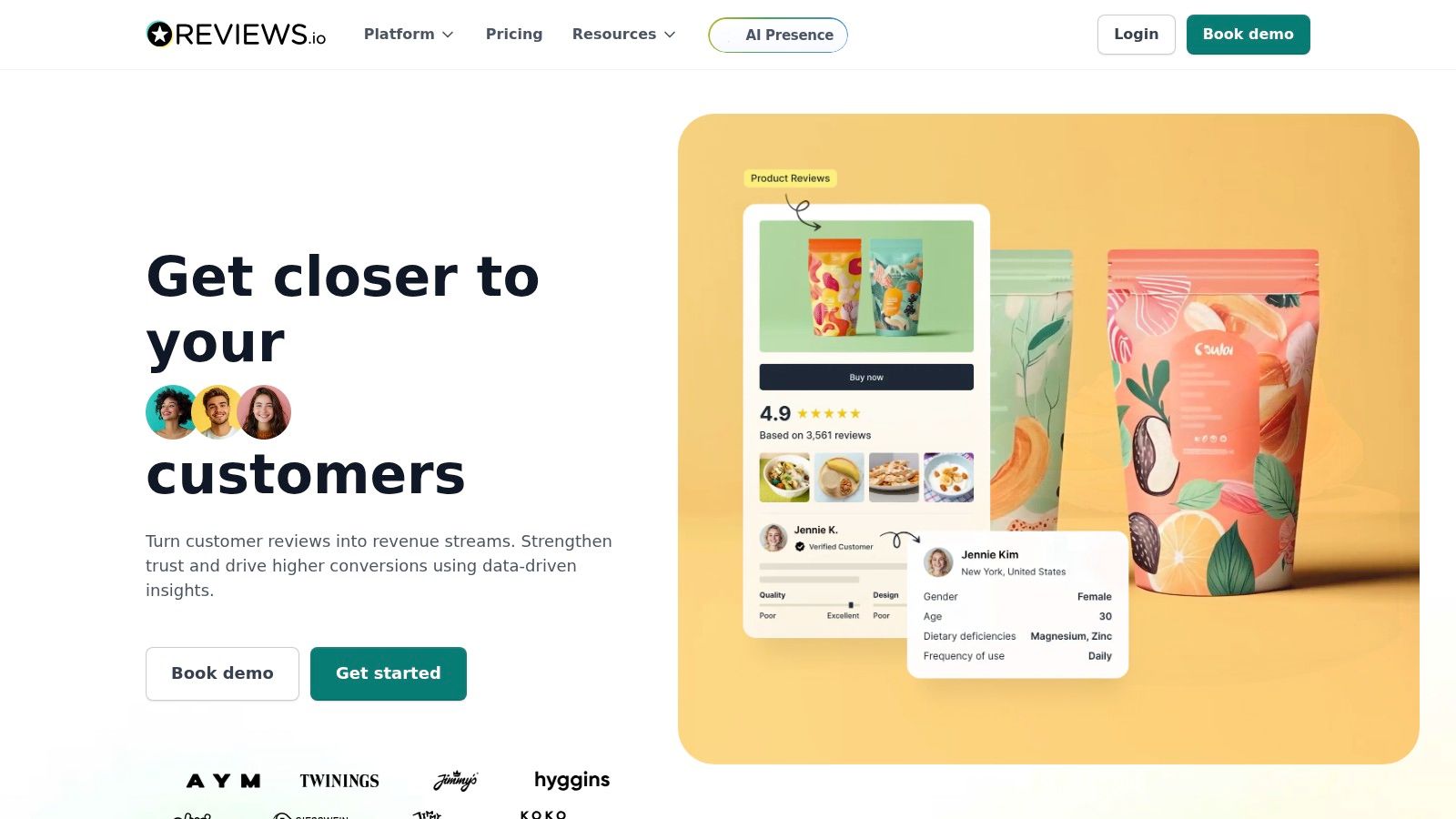
REVIEWS.io is one of the clearest Birdeye alternatives for e-commerce brands. It's built around conversion-oriented reviews and UGC, not around offline multi-location operations.
That distinction matters because many “reputation management” platforms are local-business products at heart. REVIEWS.io is much more comfortable inside Shopify, BigCommerce, and product-page optimization workflows.
Best for e-commerce and UGC-driven brands
The platform supports company, product, and local review widgets, video reviews, AI summary widgets, Google Seller Ratings support, rich snippets, and shoppable galleries. That gives merchandisers and growth marketers more to work with than a standard review feed.
This also connects to a gap in many Birdeye alternatives lists. Famewall's comparison points out that most BirdEye alternative roundups over-index on enterprise reputation management and miss the video-first testimonial niche, even though video reviews are cited there as increasing trust signals by 25% and conversion rates by up to 30%. REVIEWS.io isn't purely a testimonial tool, but it does serve brands that care about richer on-site proof.
What to like and what to verify
- Strong point: Flexible widgets and UGC support for on-site merchandising.
- Best fit: Shopify and e-commerce brands focused on conversion and visual review content.
- Check before buying: Pricing and displayed currency can vary by region, so verify the checkout context carefully.
If you sell online and want reviews to behave like merchandising assets, REVIEWS.io is much closer to the mark than a local-service-first platform.
Top 10 Birdeye Alternatives Comparison
| Product | Core features | Quality (★) | Pricing (💰) | Target (👥) | Standout (✨) |
|---|---|---|---|---|---|
| ZenX Testimonials 🏆 | In-browser HD video/audio/text capture; Google & Yelp sync; Wall of Love widgets; AI moderation & Case Study Generator | ★ 4.9, fast setup, responsive, SEO-friendly | 💰 Free-to-start + 7‑day trial; paid tiers via signup | 👥 SMBs, marketers, e‑commerce, agencies needing video-first social proof | ✨ No-install recorder; one-line embeds; exportable; AI insights |
| Podium | SMS-first review requests, AI inbox, unified messaging, CRM/POS integrations | ★ 4.4, strong SMS workflows, mobile apps | 💰 Sales-quoted; can be premium | 👥 Local service, healthcare, auto, retail teams | ✨ Text-first automation & AI reply suggestions |
| NiceJob | Email/SMS requests, widgets, referral campaigns, AI replies | ★ 4.3, simple setup, ROI-focused | 💰 Affordable SMB plans | 👥 Local SMBs seeking referrals & reviews | ✨ Referral & repeat-business automations |
| Trustpilot (Business) | Public review collection, TrustBox widgets, invites, marketing assets | ★ 4.2, recognized consumer trust, SEO lift | 💰 Tiered/annual; per-domain pricing | 👥 Brands seeking public discovery & SEO | ✨ High-consumer-traffic destination & ad-ready assets |
| Reputation (Reputation.com) | Reviews, listings, surveys, Rep Score, enterprise analytics | ★ 4.1, enterprise governance & deep analytics | 💰 Location-based / published pricing for enterprise | 👥 Multi-location enterprise brands | ✨ Standardized workflows, robust governance & add-ons |
| ReviewTrackers (by InMoment) | Monitoring 100+ sources, alerts, AI reply suggestions, competitor insights | ★ 4.0, clear dashboards & broad monitoring | 💰 Sales-quoted; location-based tiers | 👥 Multi-location brands needing broad monitoring | ✨ Wide-source monitoring with alerts & sentiment |
| GatherUp | Email/SMS requests, NPS/surveys, widgets, Listings Hub & Review Defense add-ons | ★ 4.0, straightforward, agency-friendly | 💰 Volume-friendly multi-location pricing; credits included | 👥 SMBs, agencies, franchises | ✨ Generous credits, agency white-label & exports |
| Grade.us (by Traject) | Review funnels, embeddable streams, strong white-label, API & WordPress plugin | ★ 4.0, agency-focused, functional UI | 💰 Reseller/agency pricing; white-label tiers | 👥 Agencies & resellers packaging review services | ✨ Best-in-class white-label & reseller tools |
| Broadly | AI receptionist, automated review replies, social posting, listings sync | ★ 3.9, done-for-you, phone-friendly workflows | 💰 Flat bundle pricing; higher if only reviews needed | 👥 Owner-operators wanting an all-in-one vendor | ✨ AI receptionist + managed onboarding |
| REVIEWS.io | Product/company widgets, video reviews, shoppable UGC galleries, Google Seller Ratings | ★ 4.2, e‑commerce optimized, performant widgets | 💰 Region/currency-dependent; verify at checkout | 👥 E‑commerce brands (Shopify/BigCommerce) | ✨ Video UGC, shoppable galleries & rich snippets |
Choosing the Right Birdeye Alternative
The best Birdeye alternative depends on what job the software needs to do inside your business. That sounds obvious, but it's where most evaluations go wrong. Teams compare feature lists as if every tool is solving the same problem. They aren't.
If you run a local service business and your staff already handles lead follow-up through text, Podium deserves a close look. It matches the reality of front-desk and service workflows better than platforms built around broad reporting. If you're a small local brand that mostly needs more reviews, a referral loop, and easy website proof, NiceJob is often easier to operationalize.
For agencies, the choice shifts again. GatherUp works well when you want practical multi-account execution without too much ceremony. Grade.us is the stronger option if white-label delivery is central to your business model and you need software that feels built for resale. Reputation.com enters the conversation when you're dealing with larger multi-location governance, compliance, or executive reporting structures.
E-commerce and SaaS teams should be stricter about the difference between reputation management and conversion-focused social proof. Public reviews matter, but first-party testimonials often matter more on pricing pages, product pages, landing pages, and sales collateral. That's why ZenX stands out. It's better aligned with teams that want frictionless HD video, audio, and text capture in the browser, plus a clean path to curation and publishing. That matters in a market where consumers trust online reviews as much as personal recommendations at a rate of 88%, but collecting authentic customer proof manually is still slow and messy.
There's also a quality angle that buyers often overlook. If video testimonials are part of your plan, the technical side matters. Strong testimonial video tools should support capabilities like HD or 4K recording, stabilization, auto-lighting correction, and background noise removal. A clunky recorder or low-quality output can undermine the trust you're trying to build.
Pricing structure should be part of your selection process too, but not in the simplistic “cheapest wins” way. What matters is whether the plan aligns with your use case. For example, one Team Plan in the testimonial software category offers 1,800 responses per year at 1080p HD quality, along with 20 forms and 5 video fields per form for $100 per month. The useful takeaway isn't that every team should buy that plan. It's that you should map expected volume, media quality, and campaign structure before you compare line items.
Shortlist two or three tools. Ask each vendor how migration works, how support is handled after onboarding, what data you can export, and what features require separate add-ons. Don't settle for a polished demo. Ask to see the workflows your team will touch every week.
The right platform won't just help you manage reviews. It'll shape how you collect trust, publish proof, and turn customer feedback into pipeline, revenue, and retention.
If you want a Birdeye alternative built for frictionless testimonials instead of bloated review ops, ZenX Testimonials is the one to trial first. It gives you browser-based HD video, audio, and text capture, imports third-party reviews into one library, and lets you publish polished social proof without developer dependency. For SaaS, e-commerce, agencies, healthcare, and service businesses that want reviews to drive conversion, it's a smart place to start.
Written by
Sunil
ZenX Testimonials
Sunil writes about reviews, testimonials, and the everyday work of earning customer trust.