8 Good Survey Examples to Copy in 2026
Eight good survey examples you can copy in 2026, with sample questions and tips for getting honest, useful answers.
In this article
- 1. Customer Satisfaction Survey Template
- 2. Net Promoter Score Survey Template
- 3. Post-Purchase Feedback Survey Template
- 4. Customer Effort Score Survey Template
- 5. Product Feature Feedback Survey Template
- 6. Healthcare Patient Satisfaction Survey Template
- 7. B2B Sales Enablement Survey Template
- 8. Event Attendee Experience Survey Template
- Comparison of 8 Survey Templates
- Turn Survey Insights Into Action
Are you collecting customer feedback, or just collecting noise? Many teams ask for opinions and then wonder why the answers don't drive decisions. The better approach is to use good survey examples that match the moment, the audience, and the outcome you want, whether that's improving a product, spotting friction, or turning satisfied customers into usable testimonials.
The strongest survey examples aren't long. They're clear, neutral, specific, and built around a defined objective, which lines up with long-standing survey design guidance that grew out of probability sampling and statistically defensible measurement after World War II, when survey research became central to governments and major firms. That tradition still matters because a survey only works if a sample can reliably stand in for a larger population, and that's why modern best practice still emphasizes clarity, neutrality, and pretesting before launch (Mentimeter on survey question fundamentals).
If you want feedback that people will complete, keep it short. Industry guidance commonly recommends staying under 10 minutes and around 5 to 12 questions, because drop-off rises as surveys get longer (Polling.com survey guidance). In practice, that means a sharp template beats a sprawling questionnaire, especially when you want customers to answer quickly on email, SMS, or QR code.
1. Customer Satisfaction Survey Template
A CSAT survey works best when it asks about one specific interaction. That might be a recent delivery, a support chat, a product update, or a completed appointment. The point is to capture the customer's immediate reaction while the experience is still fresh, then use that response to segment happy customers from people who need follow-up.
A simple structure usually wins here. Ask one rating question, then one open-ended follow-up that gives the customer room to explain the score. That keeps friction low and preserves enough context to tell whether the issue was product quality, service speed, or something else.
Practical rule: if the score is high, the next step should be easy to spot. A short thank-you plus a testimonial request works better than making people hunt for the next form.
For ZenX users, this is a natural bridge from feedback to social proof. You can collect a quick satisfaction rating, tag responses by sentiment, and send people who rated you highly to a video testimonial flow through the same journey. That works especially well for e-commerce post-purchase emails, SaaS feature-release feedback, and local service businesses asking about appointment completion.
A tight CSAT template can look like this:
- How satisfied were you with your recent experience?
- What's the main reason for your rating?
- Would you be open to sharing a short video about your experience?
If you're using email, send it soon after the interaction while the context is still clear. If you're using QR codes in a store, clinic, or office, place the code where the experience ends, not where it begins. For ZenX users, the most useful follow-up is the one that routes high-satisfaction responses into a testimonial request immediately, and you can pair that with ZenX guidance on collecting customer feedback.
2. Net Promoter Score Survey Template
What does NPS tell you beyond a number?
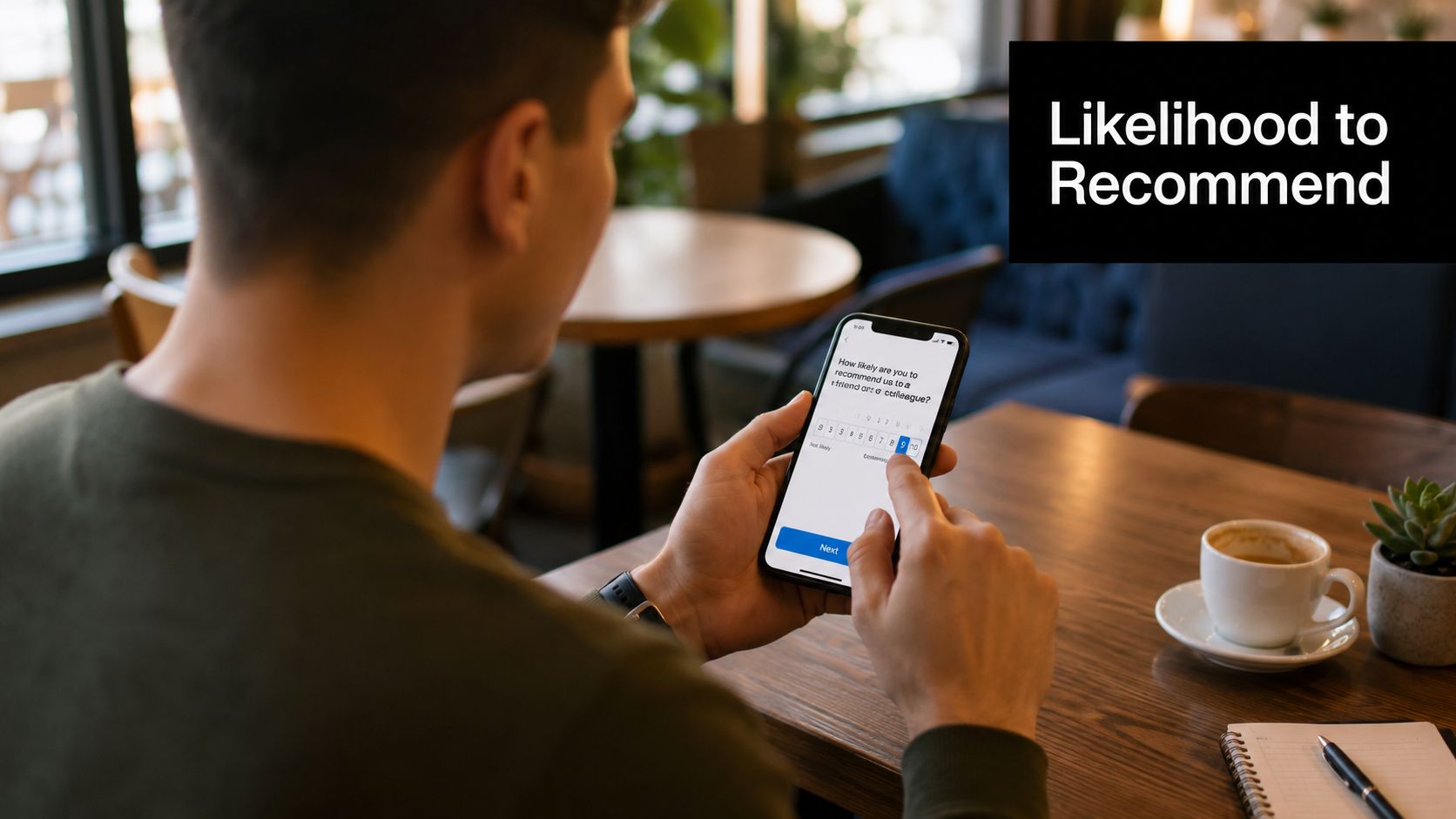
NPS is the clearest way to measure advocacy at scale. One question asks how likely someone is to recommend your company, product, or service on a 0 to 10 scale, and the answers split into Promoters, Passives, and Detractors. The metric is the percentage of promoters minus the percentage of detractors, which makes it useful when you need a simple read on loyalty and word-of-mouth potential.
The score matters, but the follow-up matters more. A promoter might be responding to a smooth onboarding experience, while a detractor might be reacting to a billing issue, a weak support handoff, or a product gap. Those are different problems, so the survey should give you one direct question that explains the rating and points to the next action.
NPS also works well on a cadence. Software teams often use it after product milestones or on a recurring schedule, while agencies and healthcare practices can send it after a project or care journey to identify advocates. For ZenX users, the highest scores are the strongest candidates for case studies and Wall of Love displays, while lower scores can guide improvement priorities and competitive analysis. If you want to turn that response flow into a structured handoff, ZenX smart forms can help route people based on their answers without adding extra friction.
If you send NPS by email, keep the ask short and direct. If you use a QR code in a physical location, make sure the scan lands on a mobile-friendly page with the 0 to 10 scale visible immediately. That matters because NPS should feel quick to answer, not like homework.
Scores are useful, but the comment is where the story starts.
A practical flow looks like this:
- Ask the recommendation score first.
- Follow with one “why?” prompt.
- Route promoters into a testimonial request.
- Route detractors into a fix-it workflow.
That approach helps teams turn strong advocacy into a testimonial pipeline. The value is not just the number, it is the next action you take with people who already trust you.
3. Post-Purchase Feedback Survey Template
Post-purchase surveys are strongest when they respect the customer's momentum. The buyer has just completed a transaction, so the survey should focus on the purchase path, product expectations, delivery, and early satisfaction. You don't need a long questionnaire here, you need a precise one that tells you whether the buying experience matched the promise.
The best versions usually stay to 3 or 4 questions at the start, because the customer is still in motion and doesn't want to pause for a mini research interview. Ask about clarity, ease, and first impressions, then use a simple follow-up to ask what stood out most. That gives you a clean view of where the journey is working and where it's introducing friction.
For e-commerce, this is a strong moment to collect unboxing reactions or ask for a short video review. For course creators, it's often the moment right after enrollment when excitement is high. For subscription products, it can help surface early churn risk before the relationship cools.
A good template often includes:
- How easy was the purchase process?
- Did the product or service match what you expected?
- What was the main reason for your answer?
- Would you share a short video review if we made it simple?
If you're using email, send it close to the transaction so the buyer remembers the details. If you're using a QR code on packaging or in a receipt insert, make the path to the survey obvious and mobile-friendly. ZenX users can connect that survey response to a testimonial form for people who give the highest ratings, which keeps the handoff from feedback to social proof very short.
The strongest follow-up is targeted, not broad. A happy first-time customer should see a different request than someone who struggled with checkout or shipping, and smart tagging makes that easy to manage.
4. Customer Effort Score Survey Template
CES is about ease, not emotion. It asks customers how simple it was to solve a problem, complete a task, or move through a process, which makes it especially useful when friction is the issue you care about most. In SaaS, that often means onboarding or support resolution. In banking, it might mean account opening. In retail, it could be returns or exchanges.
The question itself should be direct and specific. “The company made it easy to solve my problem” is stronger than a vague satisfaction prompt because it measures effort, not just mood. That distinction matters, since a customer can be satisfied and still have had to work too hard to get there.
CES is also one of the best survey types for identifying operational wins that deserve to be showcased. If a customer had a smooth setup or a fast resolution, that's not just a service metric, it's testimonial material. ZenX users can use high-effort score responses to find people who are willing to describe the process in a case study or a short text testimonial.
A useful CES flow is simple:
- Ask about the ease of the task just completed.
- Use one open prompt to identify the friction point.
- Route high-effort respondents toward a testimonial request.
Deploy it right after support interactions, onboarding completion, or a key process milestone. If the survey comes too late, the memory of the effort fades and the answer gets less useful. If you're using it in a product workflow, keep the wording tied to the exact action, because ambiguity makes the score harder to interpret.
A high CES result is more than a happy customer. It's evidence that your process works the way you intended, and that's exactly the kind of proof buyers trust when they're deciding whether to convert.
5. Product Feature Feedback Survey Template
Feature feedback surveys are where you separate nice-to-have opinions from actual product intelligence. The best ones ask about features people have really used, not features they think sound interesting. That keeps the response grounded in experience and gives product, marketing, and CX teams something they can act on.
This is the right format for releases, redesigns, and roadmap validation. Project management tools can ask about collaboration, e-commerce teams can ask about checkout flow, and analytics platforms can ask about dashboard customization or reporting. The point is to find out what people value, what they ignore, and what they'd miss if it disappeared tomorrow.
A strong feature survey usually mixes closed and open responses. Use a rating scale for usefulness, a multiple-choice question for the most valuable feature, and one open field for the “why.” That combination gives you clean segmentation plus the exact customer language your team can reuse in testimonials, landing pages, and case studies.
You can also use the responses to sharpen positioning. If users keep naming one feature as the reason they chose you, that phrasing belongs in your testimonial requests and your case study copy. ZenX users can use AI-assisted review insights and testimonial forms to collect that language in a structured way, then surface it where sales and marketing can use it.
A simple template might be:
- Which feature have you used most recently?
- How valuable was it to your workflow?
- What would you improve about it?
- Would you record a short testimonial about how you use it?
If you send this by email, make sure the list of features is tied to actual usage. If you use QR codes inside a product event or customer portal, keep the form fast enough that people don't abandon it halfway through. The best feature survey doesn't ask people to guess, it asks them to describe something they already did.
6. Healthcare Patient Satisfaction Survey Template
Healthcare surveys need more care than most because the feedback is personal and often sensitive. The standard template in healthcare is often based on HCAHPS, but clinics adapt it to fit their own context, whether that's dentistry, physical therapy, or mental health. The core areas tend to be provider communication, cleanliness, wait time, and whether the patient felt understood and supported.
Timing matters here. A survey sent too early can feel abrupt, but one sent too late loses the clarity of the visit. A practical window is 1 to 2 weeks after the appointment, when the experience is still recent and acute conditions have usually stabilized. That makes the feedback more reliable and the testimonial request less awkward.
Practical rule: in healthcare, the testimonial ask should never feel like pressure. Consent, privacy, and comfort come first.
A useful template usually includes one or two experience questions, one outcome question, and one invitation to share a story. For example, a dental practice might ask about communication and comfort, then invite a satisfied patient to describe the result in their own words. A physical therapy clinic might ask about progress and ease of care, then use that response to identify someone willing to speak about recovery.
If you're using QR codes, appointment reminder cards are a natural place to put them because the patient already knows why they're there. If you're using email, keep the language careful and direct. ZenX users in healthcare should always highlight privacy expectations and get clear consent before asking for any video testimonial or public case study. For healthcare-specific workflows, the ZenX healthcare page fits naturally into this process.
The strongest patient stories are specific. They mention communication, comfort, outcomes, and trust, which makes them more credible than generic praise and more useful for future patients who are trying to decide whether to book.
7. B2B Sales Enablement Survey Template
B2B sales surveys are most useful when they capture how buying decisions happened. That means asking prospects, trial users, or deal participants what influenced their evaluation, who was involved, and what made one vendor stand out over another. You're not just collecting feedback, you're mapping the buying process.
Surveys become sales enablement assets. A procurement team might reveal technical objections, a finance stakeholder might explain approval criteria, and an executive might focus on risk, trust, or strategic fit. Those perspectives help sales teams sharpen messaging and help marketing turn raw feedback into buyer-centric case studies.
In B2B, incentives can improve completion and make testimonial participation more likely, especially when you're asking multiple stakeholders to respond. The survey itself should be customized to the stage and the role, because a technical evaluator and a budget owner care about different things. ZenX users can collect that input, organize it by stakeholder type, and turn the strongest responses into structured case study narratives.
A useful approach is to ask:
- What problem were you trying to solve?
- Which criteria mattered most in your evaluation?
- Who else influenced the decision?
- Would you be open to a short video interview about the process?
If you send this after a trial, proposal, or closed-won deal, the timing should match the buyer journey, not your internal calendar. The most useful responses often come from the people who had to compare vendors, not just the final signer. That's why this survey type is so valuable for testimonial collection, it surfaces the language buyers already used to justify the decision.
When you turn those responses into case studies, use the buyer's own criteria in the title and the CTA. That keeps the story aligned with how future buyers think.
8. Event Attendee Experience Survey Template
Event surveys work because energy is highest right after the experience. Whether it's a conference, webinar, workshop, or product launch, attendees can still remember the speaker, the session, and the one idea that mattered most. That makes the survey one of the easiest places to capture both feedback and testimonial momentum.
A good event survey can go out before, during, or after the session, but the strongest testimonial capture usually happens immediately after the event while enthusiasm is still high. If you wait too long, people move on, and the emotional peak disappears. That's why QR codes during the event and mobile-friendly follow-up forms often outperform slower, later requests.
The survey should cover content quality, speaker effectiveness, networking value, and overall satisfaction. Then it should give attendees a direct path to share a short video if they had a strong experience. ZenX users can use that same flow to collect quick video testimonials from attendees, speakers, or guests who are willing to go on camera while the event is still fresh.
A practical structure is:
- Which session did you attend?
- How valuable was the content?
- What was the most useful takeaway?
- Would you record a 30-second video about the event?
If you're using email, send the survey within 24 hours so the experience is still top of mind. If you're using QR codes onsite, place them near session exits, registration desks, or networking areas where people are already using their phones. That makes the ask feel like part of the event, not a separate chore.
The best attendee feedback gives you more than a satisfaction score. It shows which sessions resonated, which speakers earned trust, and which moments are worth turning into launch content, speaker promotion, or post-event social proof.
Comparison of 8 Survey Templates
| Template | 🔄 Implementation complexity | ⚡ Resource requirements | 📊 Expected outcomes | 💡 Ideal use cases | ⭐ Key advantages |
|---|---|---|---|---|---|
| Customer Satisfaction (CSAT) Survey Template | Low, single/multi‑item rating, minimal branching | Low, email/SMS, mobile form | Quick satisfaction signal; promoter/detractor ID | Post-interaction, support, quick product checks | High response rate; fast, actionable insights |
| Net Promoter Score (NPS) Survey Template | Low–Medium, single core Q + follow-ups | Medium, benchmarking, trend tracking tools | Loyalty metric; promoter pool for case studies | Quarterly loyalty tracking, product-market fit | Recognized executive metric; correlates with growth |
| Post-Purchase Feedback Survey Template | Low–Medium, brief multi‑question + conditional logic | Medium, transactional triggers (24–48h), SMS/email | Immediate purchase-experience insights; testimonial candidates | E‑commerce, subscriptions, recent buyers | High relevance timing; converts buyers to reviewers |
| Customer Effort Score (CES) Survey Template | Low, single-statement effort rating | Low, triggered after interactions/support | Identifies friction points; predicts repeat behavior | Onboarding, support cases, returns | Actionable process insights; quick to run |
| Product Feature Feedback Survey Template | Medium–High, matrices, comparisons, branching | Medium–High, segmentation, product usage data | Feature prioritization; marketing language for testimonials | Feature launches, product teams, beta tests | Detailed product insights; phrasing for testimonials |
| Healthcare Patient Satisfaction Survey Template | Medium, standardized items + consent/workflows | High, HIPAA compliance, secure data handling | Quality metrics; vetted patient testimonials | Hospitals, clinics, therapy practices | Regulatory alignment; trust-building testimonials |
| B2B Sales Enablement Survey Template | High, longer, multi‑stakeholder, detailed questions | High, incentives, executive coordination | Deep buyer insights; authoritative case study candidates | Enterprise sales, procurement, trials | Decision‑maker testimonials; competitive positioning |
| Event Attendee Experience Survey Template | Low–Medium, pre/during/post variants, real‑time capture | Medium, QR/apps, rapid follow-up workflows | Immediate attendee sentiment; sponsor/ROI testimonials | Conferences, webinars, product launches | High engagement; timely testimonial capture |
Turn Survey Insights Into Action
The best survey is the one you act on. These good survey examples are useful because they do more than collect opinions, they create a repeatable path from response to decision, and from positive response to proof. If you only store the answers, you get data. If you route the right answers into follow-up, you get momentum.
That's the true value of short, well-timed surveys. A CSAT form can tell you who's happy right now. An NPS prompt can show who's likely to recommend you. A post-purchase survey can surface buyers who are ready to share an unboxing story, and a B2B or event survey can uncover the exact language future buyers use to justify trust. The common thread is not the question type, it's the workflow behind it.
Survey design guidance across the field keeps pointing to the same basics, clear wording, neutral phrasing, one concept at a time, and pretesting before launch. That's not busywork. It's what keeps your feedback credible enough to use in product decisions, case studies, and testimonial capture. It also explains why a tightly structured response form often outperforms a loose “leave us feedback” box, because structured inputs are easier to segment, compare, and act on.
If your team needs social proof, don't wait for it to appear on its own. Build the request into the survey path, tag the right respondents, and make the next step obvious. ZenX Testimonials can help centralize video, text, and review responses so you can turn survey signals into usable customer stories without rebuilding the process every time.
ZenX Testimonials helps teams collect structured feedback, route satisfied respondents into video or text testimonial flows, and organize responses for follow-up. If you want to turn strong survey results into publishable social proof, visit ZenX Testimonials and set up a workflow that connects feedback collection with testimonial capture.
Written by
Sunil
ZenX Testimonials
Sunil writes about reviews, testimonials, and the everyday work of earning customer trust.